





Deepeeka
-


Stage Combat Hersir Viking Sword
Our Stage Combat swords feature tempered, high carbon steel blades and are designed for light combat use. They have durable, thick edges, more than suitable for the rigours of stage combat and display fights. They also feature rounded tips for extra safety. Stage Combat swords are noticeably heavier than historical replicas due to the added weight afforded by the thicker edges. These swords are not designed for re-enactment use.
Our Hersir Viking Sword is a historically accurate replica of a Viking Sword. This style of Viking era sword is referred to as a Type H hilt in Petersen's Typology and has a triangular pommel. It seems this type is typically thought to have been found extensively in Norway, but as far south as Switzerland and Yugoslavia, and that the type H seems to have been in use about latter 8th c. to into the 10th.
Overall Length: 97.5cm
Blade Length: 79cm
Blade Width: 5.7cm
Blade Thickness: 0.5cm
Weight: 1672g
Point of Balance: 13cm
Material: EN45 High Carbon Steel
Edge: Blunt
Pommel: Peened
Scabbard: Leather, wood, steel
All dimensions are approximate and may vary from piece to piece.Buy the Hersir Viking Sword with confidence from the UK’s leading Viking Sword retailer.
Learn More -


Roman Mainz Gladius - RGZM
The RGZM Roman Mainz Gladius is a replica of a famous gladius found in the Rhine River in Mainz, Germany. The original has been part of the British Museum's collection but there is a replica of the gladius found in the RGZM museum in Germany. The Mainz Gladius was an early version of the Pompeii Gladius when it was introduced by the Romans back in 20 BC. Eventually, the Mainz Gladius was overtaken by the popularity of the Pompeii.
Learn More
Overall Length: 76cm
Blade Length: 55cm
Blade Width: 7cm
Weight: 1.4kg
Material: High-carbon steel
All dimensions are approximate and may vary from piece to piece. -


Roman Mainz Gladius
The Roman Gladius was the primary weapon of the Roman Legionary and was used in conjunction with the 'Scutum' (shield) and 'Pilum' (spear). Its design was strongly influenced by the swords used by the Iberian (Spanish) Celts. It was predominantly designed as a thrusting weapon and was in use in one form or another from the 4th Century BC to the 3rd Century AD.
This sword ("gladius" in Latin) found in Mainz, Germany has a leaf-shaped, double-edged blade. It was as effective for cuts as it was for thrusts, which means it was the perfect sword for close combat. The bone grip is characteristic of this type of gladius and the guard prevents your hand from slipping onto the blade after a strong thrust. The ample pommel keeps your hand on the grip after strong cuts. A scabbard with ornamental brass applications comes with this Mainz type gladius.Our Roman Mainz Gladius features a turned wood pommel and bone grip. The straight blade is hand forged from steel and is housed in a wooden scabbard with red leather covering and decorated brass fittings.
This sword is not designed or recommended for contact reenactment (fighting) but is favoured by living history enthusiasts.
Overall Length: 72cm
Blade Length: 54cm
Blade Width: 6.5cm
Blade Thickness: 0.5cm
Weight: 818g
Material: EN45 High Carbon Steel
Edge: Blunt
Pommel: Nut
Scabbard: Wood, Leather, Brass
All dimensions are approximate and may vary from piece to piece.Buy the Roman Mainz Gladius with confidence from the UK’s leading Roman sword retailer.
Learn More -


Spartan Sword with Baldric
Our Spartan Sword is inspired by those wielded by the hoplites in King Leonidas’s army when defending the Hot Gates against attack from the Persian Army.
It features a blackened solid steel guard and leather wrapped grip. The blade is forged from steel and is designed for hacking and slashing. It comes complete with a leather scabbard and baldric strap designed to be worn over the shoulder.
This sword features a blunt blade and is designed for display only.
Overall Length: 69cm
Blade Length: 53cm
Grip length: 11cm
Weight: 1314g
Blade width (base): 3.5cm
Blade: EN45 High Carbon Steel
Edge: Blunt
Pommel: Peened
Scabbard: Leather
All dimensions are approximate and may vary from piece to piece.Buy the Spartan Sword with confidence from the UK’s leading Greek sword retailer.
Learn More -

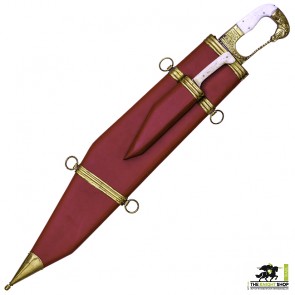
Horse Head Falcata (Kopis)
The Celt-Iberians of Roman times were justly famed for their weapons, such as the Falcata; one of the most devastating swords ever made! The inward curving blade delivers a tremendous blow and could split both shield and helmet. Considered to be of Greek, or possibly Etruscan origin, this sword spread into Southern Russia and also Spain. It was in Spanish hands that it was most feared by the Romans.The blade is forged from high carbon steel and is topped by a bronze horse-head hilt and real bone grip.
Our Falcata comes complete with a wooden scabbard covered in red leather. Attached to the scabbard is a small knife with bone handle and steel blade.
Total Length: 63cm
Blade Length: 51cm
Grip Length: 8cm
Weight: 1344g
Blade Thickness (base): 0.6cm
Blade Width (base): 6.26cm
Point of Balance (PoB): 14cm
Blade: EN45 High Carbon Steel
Edge: Blunt
Pommel: Integrated
Scabbard: Leather
All dimensions are approximate and may vary from piece to piece.Buy the Celtic sword with confidence from the UK’s leading Celtic sword retailer.
Learn More -


Roman Legionary Pompeii Gladius
The Roman Gladius was the primary weapon of the Roman Legionary and was used in conjunction with the 'Scutum' (shield) and 'Pilum' (spear). Its design was strongly influenced by the swords used by the Iberian (Spanish) Celts. It was predominantly designed as a thrusting weapon and was in use in one form or another from the 4th Century BC to the 3rd Century AD.
The Pompeii Gladius takes its name from the archaeological site in Italy where, during excavations, 4 such swords were found. The swords are dated to before 79AD - the year that Pompeii was buried in volcanic ash. The Pompeii Gladius, along with the earlier Mainz Pattern Gladius, would have been issued to the garrison at Hadrian’s Wall. Examples can be seen in H. Russell Robinson’s book "What The Soldiers Wore On Hadrians Wall'".
Our Pompeii Gladius features a turned wood pommel and bone grip. The straight blade is hand forged from steel and housed in a wooden scabbard with red leather covering and brass fittings.
This sword is not designed or recommended for contact reenactment (fighting) but is favoured by living history enthusiasts.
Total Length: 76cm
Blade Length: 49cm
Scabbard: Wood and Leather
All dimensions are approximate and may vary from piece to piece.Buy the Roman Legionary Pompeii Gladius with confidence from the UK’s leading Roman sword retailer.
Learn More -

Roman Pompeii Gladius - Decorated
The Roman Gladius was the primary weapon of the Roman Legionary and was used in conjunction with the 'Scutum' (shield) and 'Pilum' (spear). Its design was strongly influenced by the swords used by the Iberian (Spanish) Celts. It was predominantly designed as a thrusting weapon and was in use in one form or another from the 4th Century BC to the 3rd Century AD.
The Pompeii Gladius takes its name from the archaeological site in Italy where, during excavations, 4 such swords were found. The swords are dated to before 79AD - the year that Pompeii was buried in volcanic ash. The Pompeii Gladius, along with the earlier Mainz Pattern Gladius, would have been issued to the garrison at Hadrian’s Wall. Examples can be seen in H. Russell Robinson’s book "What The Soldiers Wore On Hadrians Wall'".
Our Pompeii Gladius features a turned wood pommel and bone grip. The straight blade is hand forged from steel and in housed in a wooden scabbard with red leather covering and decorated brass fittings. This sword is not designed or recommended for contact reenactment (fighting) but is favoured by living history enthusiasts.
Overall Length: 70cm
Blade Length: 48cm
Width: 4.9cm
Grip Length: 10.8cm
Weight: 1135g
Thickness: 5mm
P.O.B: 11cm
Edge: Blunt
Pommel: Threaded
Scabbard: Wood, Leather, Brass
All dimensions are approximate and may vary from piece to piece.Buy the Roman Pompeii Gladius – Decorated with confidence from the UK’s leading Roman sword retailer.
Learn More -
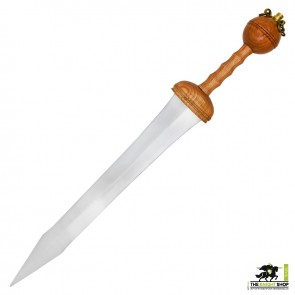
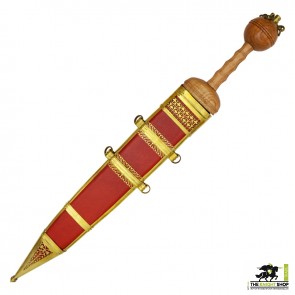
Dubrabica Roman Gladius
Step into the ranks of Roman military elite with the Dubravica Roman Gladius, a meticulously crafted reproduction based on a rare archaeological find near Dubravica in Eastern Europe. Unlike the standard legionary gladius, this extraordinary piece features a wooden pommel crowned with four brass rings, believed to denote rank or ceremonial significance.
Learn More
Crafted by Deepeeka, a global leader in historical replicas, this gladius brings together archaeological accuracy, craftsmanship, and heritage—ideal for discerning collectors, museums, and Roman reenactment specialists.
Blade Material: High Carbon Steel
Pommel Material: Hardwood with four bronze rings
Grip: Ribbed wooden handle
Scabbard: Ornate leather with brass detailing
Total Length: 76cm
Blade Length: 54.5cm
Blade Width: 6.5cm
Guard Width: 9cm
Grip Length: 10.5cm
P.O.B (from guard): 11cm
Edge: Blunt
All dimensions are approximate and may vary from piece to piece. -


Seax of Beagnoth
The Seax of Beagnoth (also known as the Thames scramasax) is a 9th century Anglo-Saxon seax (single-edged knife). It was found in the River Thames in 1857, and is now at the British Museum in London.
On one side of the blade is the only known complete inscription of the twenty-eight letter Anglo-Saxon runic alphabet, as well as the name "Beagnoth" in runic letters. It is thought that the runic alphabet had a magical function, and that the name Beagnoth is that of either the owner of the weapon or the smith who forged it.
Although many Anglo-Saxon and Viking swords and knives have inscriptions in the Latin alphabet on their blades, or have runic inscriptions on the hilt or scabbard, the Seax of Beagnoth is one of only a handful of finds with a runic inscription on its blade.Our faithful replica is based on the dimensions of the original and has a hand forged steel blade with wood grip and hand crafted leather scabbard.
Total length: 73.5cm
Blade length: 55.5cm
Grip length: 18cm
Weight: 906g
Blade width (base): 4.3cm
Blade: EN45 High Carbon Steel
Edge: Blunt
Scabbard: Stitched Leather
All dimensions are approximate and may vary from piece to piece.Buy the Seax of Beagnoth with confidence from the UK’s leading Viking sword retailer.
Learn More -
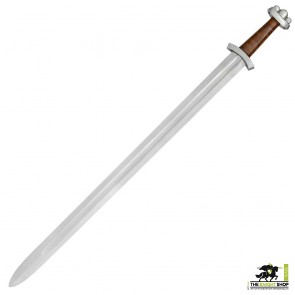
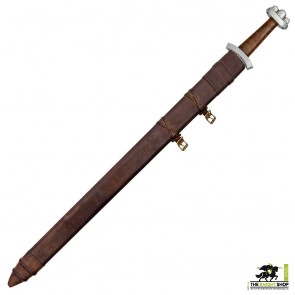
Three Lobe Viking Sword
On the 8th June 793 the first Viking attack is recorded in England. The abbey of Lindisfarne in Northumbria, a centre of learning that was famous across Europe was destroyed in a Viking raid. Monks were killed or taken away as slaves and the church treasures were taken away. From this moment onwards, Viking raids on England became more frequent until they were eventually defeated in a series of battles by King Alfred the Great. The last Viking raid on England was defeated by King Harold II in 1066. The Vikings were ferocious warriors and saw death in battle as means to entering the Halls of Valhalla – where they could fight all day and feast all night.
Our 3 Lobe Viking Sword is based on a late Viking design from around the 11th century and is contemporary with the Battle of Stamford Bridge in 1066. A similar sword was found on Canwick Common in Norfolk and is now held in the British Museum collection.
It features a forged and fullered steel blade designed for hacking and slashing and is hilted with a short guard and 3 lobed pommel. The wooden scabbard is wrapped with brown leather to match that of the leather wrapped sword grip. Although this sword has a forged blade it is not tempered and is not suitable for combat.
Total Length: 95cm
Blade Length: 79cm
Grip Length: 10.5cm
Weight: 1352g
Blade Thickness (base): 0.6cm
Blade Width (base): 4.4cm
Point of Balance (PoB): 17cm
Blade: EN45 High Carbon Steel
Edge: Blunt
Pommel: Peened
Scabbard: Wood, Leather
All dimensions are approximate and may vary from piece to piece.Buy the Three Lobe Viking Sword with confidence from the UK’s leading Viking sword retailer.
Learn More