





Marto
Marto is a manufacturer of traditional swords, located in Toledo, Spain. Marto has collected over 100 years of knowledge and experience in the specialised craft of their swords, armour and weapons.
Marto was founded to regain the testimony and the techniques of the sword master-craftsman tradition which was so prominent in Toledo. Marto is very proud to maintain to this day the “Secret of the Templar” when manufacturing their swords, giving prestige and continuity to the famous Toledo Steel.
-
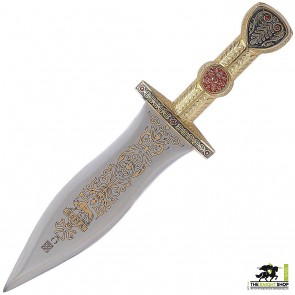
Roman Dagger - Gold
The Romans are known to have borrowed ideas on the weapons of their enemies. Initially, they used weapons of Etruscan and Greek-style or, when confronted with the Celts, adopted their equipment. To defeat the Carthaginians built a fleet based on the Carthaginian model. Once a weapon is adopted it was standard. The weapons changed over the history of Rome, although its equipment and its use were never individual. Almost all Roman swords and daggers were double-edged and could be used for both cutting and threading.
Learn More
The pugio was a small dagger used by the ancient Roman soldiers possibly as an auxiliary weapon. Like other equipment of the Legionnaires, the dagger had a series of changes throughout the I century. Generally had a long blade and leaf-shaped, between 18 and 28 centimeters long and 5 centimeters or more across. It was ideal for threading; a good rush can pierce a chainmail weapon.
Total length: 38cm
Weight: 900g
Blade: Stainless Steel
Edge: Blunt
Scabbard: None
All dimensions are approximate and may vary from piece to piece. -
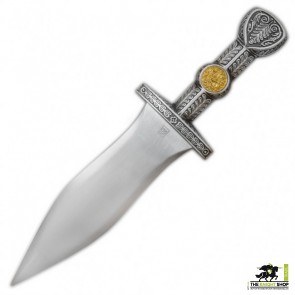
Roman Dagger - Silver
The Romans are known to have borrowed ideas on the weapons of their enemies. Initially, they used weapons of Etruscan and Greek-style or, when confronted with the Celts, adopted their equipment. To defeat the Carthaginians built a fleet based on the Carthaginian model. Once a weapon is adopted it was standard. The weapons changed over the history of Rome, although its equipment and its use were never individual. Almost all Roman swords and daggers were double-edged and could be used for both cutting and threading.
Learn More
The pugio was a small dagger used by the ancient Roman soldiers possibly as an auxiliary weapon. Like other equipment of the Legionnaires, the dagger had a series of changes throughout the I century. Generally had a long blade and leaf-shaped, between 18 and 28 centimeters long and 5 centimeters or more across. It was ideal for threading; a good rush can pierce a chainmail weapon.
Total length: 38cm
Weight: 900g
Blade: Stainless Steel
Edge: Blunt
Scabbard: None
All dimensions are approximate and may vary from piece to piece. -


Barbarian Sword
History, legends, and films (Conan) remind us of the Slavic, German, and Frank origin tribes that, from the third century to the eighth century, devastated the land of Europe, conquering even Rome. Called the "Barbarians" due to their uncivilized customs, this term happened to reach diabolical connotations for their rude and savage nature.
Learn More
The Barbarian sword, bronze finished with a blood grooved blade, depicts a winged two-headed dragon. In a world where strength was the law, Barbarian swords were robust and powerful, a symbol of authority and respect. This group of tribes ruled in a fragmented way and lacked a strong political organization in Europe until the beginning of Charlemagne's empire.
Total Length: 116cm
Weight: 1.8kg
Blade: AISI 440 Stainless Steel
Edge: Blunt
All dimensions are approximate and may vary from piece to piece. -
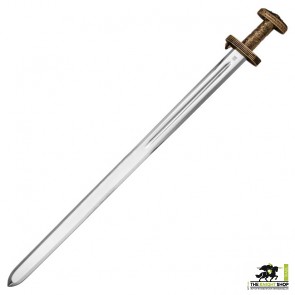
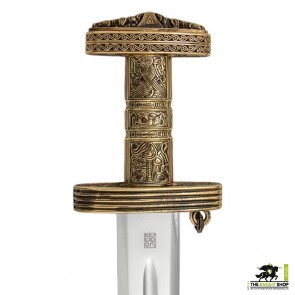
The Oslo Viking Sword
Our Marto Viking Sword was hand-made by Marto of Toledo Spain, a reproduction of a Viking sword of the 9th -10th century. The Viking raids sudden appearance by the end of the 8th century are attributed to overpopulation and opportunity. The increase in trade in Europe meant increased chances for piracy.
Learn More
The Viking Sword has a forged and fully tempered stainless steel blade that has been polished and detailed. The bronze plated cast metal hilt is finely worked with geometrical and abstract figures. The guard is short and elliptical, the handgrip is straight and the pommel is specular to the guard even if of reduced size.
Total Length: 92cm
Weight: 1.7kg
Blade: AISI 440 Stainless Steel
Edge: Blunt
Scabbard: None
All dimensions are approximate and may vary from piece to piece. -
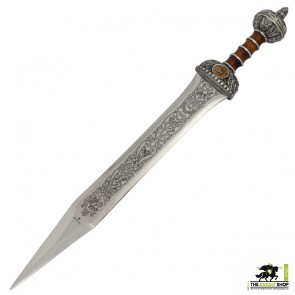
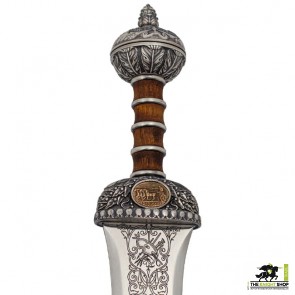
Roman Julius Caesar Gladius - Silver
Roman Gladius, Mainz type, was used between the second century B.C. and I A.D. Julius Caesar, Gaius Julius Caesar (101 b.C. – 44 b.C.) was the greatest soldier and political leader of ancient Roma. During his lifetime the frontiers of the empire were pushed forward and secured; Rome was transformed from a republic into a government with a single ruler, and Caesar was its first dictator.
Learn More
He wrote some of the finest works of history in Latin, describing the campaigns he fought in Gaul and the Civil Wars; he was an architect, a mathematician, and one of the ancient’s world orators.
Total Length: 71cm
Weight: 1.5kg
Width: 9cm
Blade: High Carbon Steel
Edge: Blunt
Scabbard: None
All dimensions are approximate and may vary from piece to piece. -
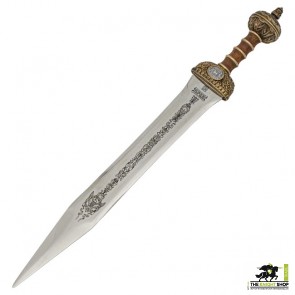
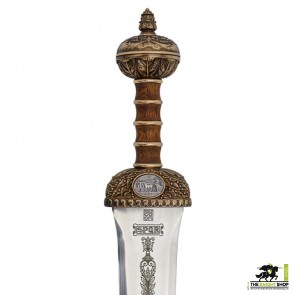
Roman Julius Caesar Gladius - Bronze
Roman Gladius, Mainz type, was used between the second century B.C. and I A.D. Julius Caesar, Gaius Julius Caesar (101 b.C. – 44 b.C.) was the greatest soldier and political leader of ancient Roma.
Learn More
During his lifetime the frontiers of the empire were pushed forward and secured; Rome was transformed from a republic into a government with a single ruler, and Caesar was its first dictator. He wrote some of the finest works of history in Latin, describing the campaigns he fought in Gaul and the Civil Wars; he was an architect, a mathematician, and one of the ancient’s world orators.
Total Length: 71cm
Weight: 1.5kg
Width: 9cm
Blade: High Carbon Steel
Edge: Blunt
Scabbard: None
All dimensions are approximate and may vary from piece to piece. -
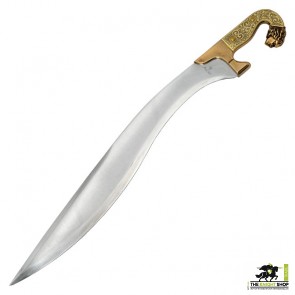
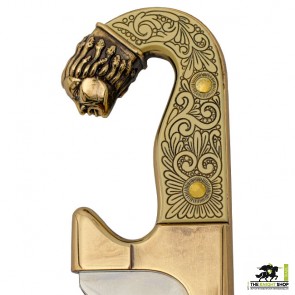
Iberian Falcata - Bronze
The falcata is a type of weapon, a sword of steel originated in Iberia, and therefore related to the Iberian native populations before the Roman conquest. It was used by the Iberian countries or neighbors like the Celtiberians being the most common sword in the area of the peninsula. Roman chroniclers praised the quality of the iron that was used for the construction of the Hispanic weapons; they were surprised by its cutting ability and flexibility, one of the most prized and sought features in its manufacture.
Learn More
As a curious note, reflecting the effectiveness of these weapons, after the first battles in the Iberian Peninsula, an order was given to Roman troops to reinforced with iron the edges of their shields, possibly due to the cutting power of the falcatas, much higher than the straight swords and sabers.
Total Length: 60cm
Blade Length: 50cm
Grip Length: 10cm
Weight: 1.5kg
Blade: Stainless Steel
Edge: Blunt
Scabbard: None
All dimensions are approximate and may vary from piece to piece. -


Charles V Longsword - Silver
Charles I of Spain and V of the Holy Roman Empire, called "Caesar", is elected Holy Roman Emperor on the death of his grandfather Maximilian in 1519. Charles I of Spain and V of Germany was known in his time as "THE Emperor" since no king ever managed to gather under his command such an immense empire.
Learn More
He retired to the Monastery of Yuste where he remained a year and a half in retreat, away from the cities and political life, and accompanied by the order of the Jerónimos who spiritually guided the monarch until his last days. On 21 September 1558 he died of malaria. The coffin of Carlos I is located in the Royal Crypt of the Monastery of El Escorial known as the Pantheon of the Kings.
It is one of the most spectacular swords in the history of Spain.
Total Length: 120cm
Weight: 2.2kg
Edge: Blunt
Scabbard: None
All dimensions are approximate and may vary from piece to piece. -


Charles V Sword
Charles I of Spain and V of the Holy Roman Empire, called "Caesar", is elected Holy Roman Emperor on the death of his grandfather Maximilian in 1519. Charles I of Spain and V of Germany was known in his time as "THE Emperor" since no king ever managed to gather under his command such an immense empire.
Learn More
He retired to the Monastery of Yuste where he remained a year and a half in retreat, away from the cities and political life, and accompanied by the order of the Jerónimos who spiritually guided the monarch until his last days. On 21 September 1558 he died of malaria. The coffin of Carlos I is located in the Royal Crypt of the Monastery of El Escorial known as the Pantheon of the Kings.
It is one of the most spectacular swords in the history of Spain.
Total Length: 100cm
Blade Length: 83cm
Width: 21cm
Weight: 2.2kg
Edge: Blunt
Scabbard: None
All dimensions are approximate and may vary from piece to piece. -

Philip II Sword
Philip II of Spain (1527-1598) was the son and heir of Charles I of Spain. He was the King of Spain, Naples, Sicily, and Portugal, and also the King of England by his marriage to Mary I. He died on September 13, 1598, at the age of 71, in the monastery of San Lorenzo de El Escorial.
Learn More
His reign was characterized by global exploration and territorial expansion across the Atlantic and Pacific oceans, leading the Hispanic Monarchy to be the first power in Europe.
This chiseled bow sword, with bow garnish, is typical of the Spanish Renaissance. The straight and long blade is wielded with one hand.
Total Length: 112cm
Blade Length: 92cm
Edge: Blunt
Scabbard: None
All dimensions are approximate and may vary from piece to piece.