





Roman
-


Late Roman 3rd Century Roman Spatha
The Roman cavalry used a much longer sword, the so called spatha. Towards end of the second century that spatha gradually replaced the short sword also for the infantry. The hilt is finished in polished bone with brass accents. Includes a matching wood scabbard with dark grey leather wrap.
Learn More
Overall Length: 96cm
Blade Length: 71cm
Blade Width: 5cm
Weight: 1.3kg
Material: High-carbon steel
All dimensions are approximate and may vary from piece to piece. -


Julius Caesar Roman Sword
Julius Caesar was one of Rome’s most successful generals. He played a pivotal role in the demise of the Roman Republic and the rise of the Roman Empire that followed. His victories in the Gallic Wars extended Rome’s territory to the English Channel and the Rhine and in 54BC he invaded Britain. He was ordered to step down from his military command after the conclusion of the Gallic Wars but instead he crossed the Rubicon with the 13th Legion and entered Roman Italy under arms, where he quickly seized power and became Emperor.
Learn More
Our Julius Caesar Sword is crafted in the world famous Art Gladius factory in Toledo, Spain. The antiqued bronze hilt is heavily adorned with Roman style reliefs and features the letters SPQR (Senātus Populus que Rōmānus) on the guard. The large pommel is topped with an Imperial Eagle (Aquila). The Pompeii style stainless steel blade is richly adorned with engravings. This sword is designed for display only.
Total Length: 78cm
Blade Length: 60cm
Grip Length: 9cm
Weight: 1562g
Blade Thickness (base): 0.5cm
Blade Width (base): 5.4cm
Point of Balance (PoB): 13cm
Blade: Stainless Steel
Edge: Blunt
Pommel: Threaded
Scabbard: None
All dimensions are approximate and may vary from piece to piece. -


Roman Gladiator Sword
*Our remaining stock of this sword features very faint, almost hair-thin scratches on the blade that can only be seen in certain lights.
Gladiators (Latin for Swordsman) were armed combatants from the Roman Empire who entertained audiences in the amphitheatre, the most famous of which was the Colosseum in Rome. Some gladiators were Roman citizens who desired fame and glory but most were slaves or criminals. Gladiators symbolised Rome’s martial ethics in fighting and dying well and they were celebrated in both high and low art. There are 19 amphitheatres in Britain, some of the most famous and best preserved are at Chester, Caerleon and St. Albans.
Learn More
Our Roman Gladiator Sword is crafted in the world famous Art Gladius factory in Toledo, Spain. The gilded hilt is heavily adorned with Roman style reliefs and features the letters SPQR (Senātus Populus que Rōmānus) on the guard. The large pommel is topped with an Imperial Eagle (Aquila). The Pompeii style stainless steel blade is richly adorned with engravings. This sword is designed for display only.
Total Length: 78.5cm
Blade Length: 59.5cm
Grip Length: 9cm
Weight: 1516g
Blade Thickness (base): 0.5cm
Blade Width (base): 5.4cm
Point of Balance (PoB): 12cm
Blade: Stainless Steel
Edge: Blunt
Pommel: Threaded
Scabbard: None
All dimensions are approximate and may vary from piece to piece. -


Roman Mainz Gladius
Our Roman Mainz Gladius features a turned wood pommel and bone grip. The straight blade is hand forged from steel and is housed in a wooden scabbard with red leather covering and decorated brass fittings.
Learn More
This sword is not designed or recommended for contact reenactment (fighting) but is favoured by living history enthusiasts.
Overall Length: 72cm
Blade Length: 54cm
Blade Width: 6.5cm
Blade Thickness: 0.5cm
Weight: 818g
Material: EN45 High Carbon Steel
Edge: Blunt
Pommel: Nut
Scabbard: Wood, Leather, Brass
All dimensions are approximate and may vary from piece to piece. -
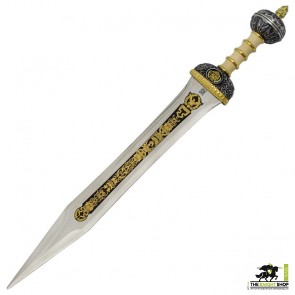
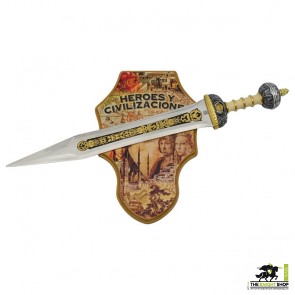
Julius Caesar Gladius - Limited Edition
Julius Caesar, Gaius Julious Caesar was the greatest soldier and political leader of ancient Rome. During his lifetime the frontiers of the empire were pushed forward and secured; Rome was transformed from a republic into a government with a single ruler, and Caesar was its first dictator. He wrote some of the finest works of history in Latin, describing the campaigns he fought in Gaul and the Civil Wars; he was an architect, a mathematician, and one of the ancient’s world orators.
Learn More
There is no doubt that Caesar was ambitious and that he enjoyed the great power placed in his hands. It is said that he wished to be crowned king. This was the reason that the conspirators led by Cassius and Brutus gave for his murder: Caesar has become too powerful and dangerous for the survival of the Republic.
Total Length: 71cm
Weight: 1.8kg
Width: 9cm
Blade: Stainless Steel
Edge: Blunt
Scabbard: None
All dimensions are approximate and may vary from piece to piece. -
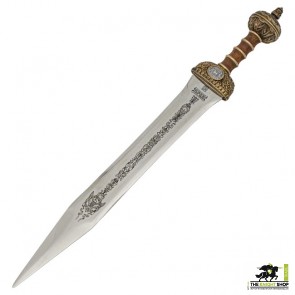
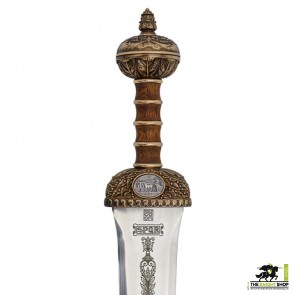
Roman Julius Caesar Gladius - Bronze
Roman Gladius, Mainz type, was used between the second century B.C. and I A.D. Julius Caesar, Gaius Julius Caesar (101 b.C. – 44 b.C.) was the greatest soldier and political leader of ancient Roma.
Learn More
During his lifetime the frontiers of the empire were pushed forward and secured; Rome was transformed from a republic into a government with a single ruler, and Caesar was its first dictator. He wrote some of the finest works of history in Latin, describing the campaigns he fought in Gaul and the Civil Wars; he was an architect, a mathematician, and one of the ancient’s world orators.
Total Length: 71cm
Weight: 1.5kg
Width: 9cm
Blade: High Carbon Steel
Edge: Blunt
Scabbard: None
All dimensions are approximate and may vary from piece to piece. -
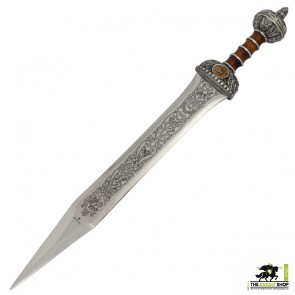
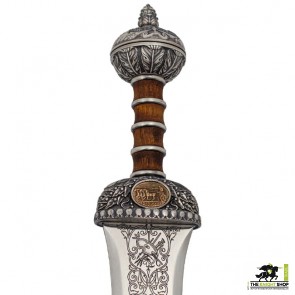
Roman Julius Caesar Gladius - Silver
Roman Gladius, Mainz type, was used between the second century B.C. and I A.D. Julius Caesar, Gaius Julius Caesar (101 b.C. – 44 b.C.) was the greatest soldier and political leader of ancient Roma. During his lifetime the frontiers of the empire were pushed forward and secured; Rome was transformed from a republic into a government with a single ruler, and Caesar was its first dictator.
Learn More
He wrote some of the finest works of history in Latin, describing the campaigns he fought in Gaul and the Civil Wars; he was an architect, a mathematician, and one of the ancient’s world orators.
Total Length: 71cm
Weight: 1.5kg
Width: 9cm
Blade: High Carbon Steel
Edge: Blunt
Scabbard: None
All dimensions are approximate and may vary from piece to piece. -


Roman Mainz Gladius - RGZM
The RGZM Roman Mainz Gladius is a replica of a famous gladius found in the Rhine River in Mainz, Germany. The original has been part of the British Museum's collection but there is a replica of the gladius found in the RGZM museum in Germany. The Mainz Gladius was an early version of the Pompeii Gladius when it was introduced by the Romans back in 20 BC. Eventually, the Mainz Gladius was overtaken by the popularity of the Pompeii.
Learn More
Overall Length: 76cm
Blade Length: 55cm
Blade Width: 7cm
Weight: 1.4kg
Material: High-carbon steel
All dimensions are approximate and may vary from piece to piece. -


Roman Legionary Pompeii Gladius
Our Pompeii Gladius features a turned wood pommel and bone grip. The straight blade is hand forged from steel and housed in a wooden scabbard with red leather covering and brass fittings.
Learn More
This sword is not designed or recommended for contact reenactment (fighting) but is favoured by living history enthusiasts.
Total Length: 76cm
Blade Length: 49cm
Scabbard: Wood and Leather
All dimensions are approximate and may vary from piece to piece. -

Roman Pompeii Gladius - Decorated
The Roman Gladius was the primary weapon of the Roman Legionary and was used in conjunction with the 'Scutum' (shield) and 'Pilum' (spear). Its design was strongly influenced by the swords used by the Iberian (Spanish) Celts. It was predominantly designed as a thrusting weapon and was in use in one form or another from the 4th Century BC to the 3rd Century AD.
Learn More
The Pompeii Gladius takes its name from the archaeological site in Italy where, during excavations, 4 such swords were found. The swords are dated to before 79AD - the year that Pompeii was buried in volcanic ash. The Pompeii Gladius, along with the earlier Mainz Pattern Gladius, would have been issued to the garrison at Hadrian’s Wall. Examples can be seen in H. Russell Robinson’s book "What The Soldiers Wore On Hadrians Wall'".
Our Pompeii Gladius features a turned wood pommel and bone grip. The straight blade is hand forged from steel and in housed in a wooden scabbard with red leather covering and decorated brass fittings. This sword is not designed or recommended for contact reenactment (fighting) but is favoured by living history enthusiasts.
Overall Length: 70cm
Blade Length: 48cm
Width: 4.9cm
Grip Length: 10.8cm
Weight: 1135g
Thickness: 5mm
P.O.B: 11cm
Edge: Blunt
Pommel: Threaded
Scabbard: Wood, Leather, Brass
All dimensions are approximate and may vary from piece to piece.