





Scottish Medieval
-
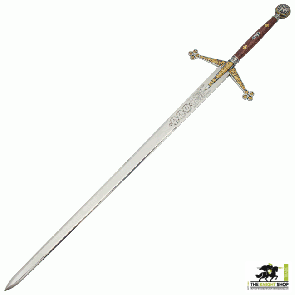
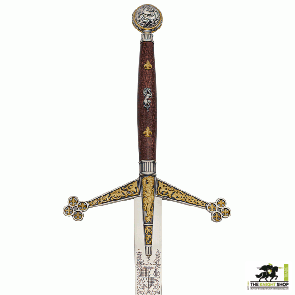
Royal Scottish Claymore
The Scottish Claymore Sword was the typical weapon of the Highland warriors since the late Middle Age, 15th to 17th century. This large two-handed broad sword was considered a rough tool, although effective. It was King James I's effective use of the Claymore sword that made it one of the symbols of national Scottish pride. The Claymore sword, feared because of its size and strength, was used in the constant clan wars as well as against the English as late as the Rebellion of 1745.
Learn More
This Scottish Claymore by Marto of Toledo, Spain, has a double-edged blade made of the finest tempered stainless steel and decorated with engravings on the upper part of the blade. The hilt is made in burnished cast metal with decorations in gold and silver-plated metal. The spheric pommel is also in cast metal, whilst the long tapered handgrip is wood. As is typical of the high Marto quality and craftsmanship standards, this Claymore sword reproduction is without comparison.
Total Length: 145cm
Blade Length: 99cm
Blade Width: 5.8cm
Blade Thickness: 0.5cm
Guard Width: 30cm
Blade: AISI 440 Tempered Stainless Steel
Edge: Blunt
Scabbard: None
Weight: 2.6kg
All dimensions are approximate and may vary from piece to piece. -
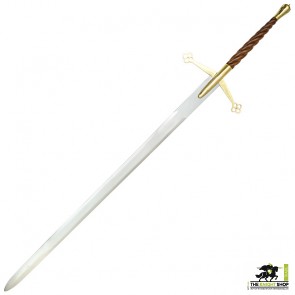

Twisted Hilt Scottish Claymore
The Claymore (from the Scottish Gaelic claidheamh-mòr, meaning “great sword”) is a Scottish variant of the late medieval 2 handed sword. It differed from other longswords of the period in that it usually had forward sloping quillons terminating in quatrefoils. Claymores were in use during constant clan warfare and fights with the English from the 15th to 17th century. Claymores did exist as early as the Wars of Scottish Independence although they were smaller and few had the characteristic quatrefoil design. The last time that claymores were seen on the battlefield in any significant number was the Battle of Killiecrankie in 1689.
Learn More
Our Twisted Hilt Scottish Claymore features a hand-forged high carbon steel blade topped with brass hilt fittings and a hand carved real wood grip. This sword has a blunt blade and is designed for display only.
Overall Length: 143cm
Blade Length: 106.5cm
Grip Length: 23cm
Weight: 2294g
Blade thickness (base): 0.5cm
Blade width (base): 5cm
Point of Balance (PoB): 19.5cm
Blade: High Carbon Steel
Edge: Blunt
Pommel: Peened
Scabbard: None
All dimensions are approximate and may vary from piece to piece. -
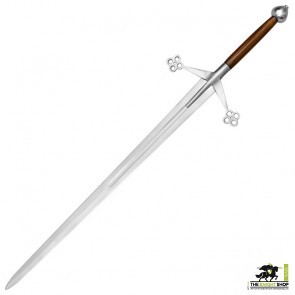
Two Handed Scottish Claymore
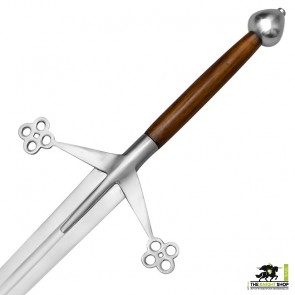
The Claymore (from the Scottish Gaelic claidheamh-mòr, meaning “great sword”) is a Scottish variant of the late medieval 2 handed sword. It differed from other longswords of the period in that it usually had forward sloping quillons terminating in quatrefoils. Claymores were in use during constant clan warfare and fights with the English from the 15th to 17th century. Claymores did exist as early as the Wars of Scottish Independence although they were smaller and few had the characteristic quatrefoil design. The last time that claymores were seen on the battlefield in any significant number was the Battle of Killiecrankie in 1689.
Learn More
Our Two Handed Scottish Claymore has a hand-forged high carbon steel blade topped with solid steel hilt fittings and a stained real wood grip. This sword has a blunt blade and is designed for display only.
Overall Length: 123cm
Blade Length: 92cm
Blade Width: 5.8cm
Blade Thickness: 0.5cm
Guard Width: 29cm
Guard Depth: 2.9cm
Grip Length: 19cm
Blade: High Carbon Steel
Edge: Blunt
Pommel: Peened
Scabbard: None
All dimensions are approximate and may vary from piece to piece. -


Brass Claymore
The claymore (from Gaelic claideamh-mor, great sword) was a Celtic two-handed sword that was usually 150 cm or longer. This length made it very difficult for opponents to approach. The claymore often had a long, leather-covered ricasso, so that the warrior could place both hands on the blade when his enemy came close. The earliest claymores were used in the 16th century, the latest in the 18th century.
Learn More
Overall Length: 133.5cm
Blade Length: 104cm
Blade Width: 5cm
Blade Thickness: 0.5cm
Guard Width: 26.5cm
Weight: 2396g
Material: Steel Blade, Wooden Grip, Brass Guard & Pommel
Edge: Blunt
Pommel: Nut
Scabbard: None
All dimensions are approximate and may vary from piece to piece. -

Honshu Historic Claymore Sword
Learn MoreThe Honshu Historic Claymore Sword is an exceptional addition to the Honshu Historic Series. It's a time-tested sword design with modern engineering. The 1065 high carbon steel blade has a deep groove and has a genuine suede wrap below the polished steel handguard. The wooden handle is wrapped in genuine brown leather with embossed cord grooves and the pommel is polished steel.
The Claymore sword slides smoothly into a premium brown leather scabbard with polished steel accents. Honshu continues to expand its exceptional sword line and this tactical Claymore sword is a must-have for your collection!
Total Length: 145cm
Blade Length: 110cm
Weight: TBC
Blade: 1065 high carbon steel
Edge: Sharp
Scabbard: Yes
All dimensions are approximate and may vary from piece to piece. -


Robert the Bruce Sword
The Robert the Bruce Sword features a forged steel blade with solid brass pommel and guard. The pommel features the rampant lion of the Bruce coat of arms whilst the guard is decorated with crusader crosses, both in red enamel. The leather and wood scabbard is decorated with a “Z” pattern and has brass scabbard loops.
Learn More
This sword is blunt and designed for display only.
Total Length: 97cm
Blade Length: 78.5cm
Grip Length: 12.5cm
Weight: 1140g
Blade Thickness (base): 0.44cm
Blade Width (base): 4.5cm
Point of Balance (PoB): 13.5cm
Blade: High Carbon Steel
Edge: Blunt
Pommel: Peened
Scabbard: Leather, Wood
All dimensions are approximate and may vary from piece to piece. -
Gallowglass Sword
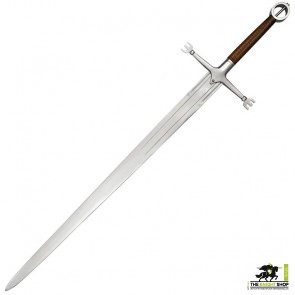
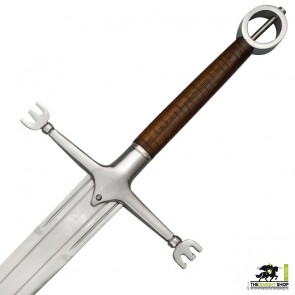
The word Gallowglass is an Anglicisation of the Irish word Gallóglaigh meaning “foreign soldiers”. They were mercenary warrior elite among Scottish clans living in the Highlands and Western Isles between the 13th and 16th century. During the 13th century they started to settle in Ireland where military chieftains would frequently use them as bodyguards as they were not subject to local feuds or influences.
Learn More
A description from 1600, speaks of the Gallowglass as "...pycked and scelected men of great and mightie bodies, crewell without compassion. The greatest force of the battell consisteth in them, chosing rather to dye than to yeelde, so that when yt cometh to handy blowes they are quickly slayne or win the fielde." They were famed for using their broadswords or claymores ("claíomh mór" - Gailic for “Great Sword”) with terrifying effect in battle.
Overall Length: 136cm
Blade Length: 104cm
Blade Width: 6.35cm
Blade Thickness: 0.6cm
Guard Width: 30cm
Guard Depth: 2.9cm
Grip Length: 18.5cm
Blade: High Carbon Steel
Edge: Blunt
Pommel: Peened
Scabbard: None
All dimensions are approximate and may vary from piece to piece. -


William Wallace Braveheart Sword
Sir William Wallace was a Scottish knight and one of the main leaders in the Wars of Scottish Independence. In September 1297 he defeated the English army at the Battle of Stirling Bridge. After the battle he was appointed Guardian of Scotland and served until he was defeated at the Battle of Falkirk in 1298. He continued to fight for Scottish independence until he was captured in 1305 executed in London for crimes of High Treason. In death his exploits passed into legend. Sir Walter Scott wrote about him in “Exploits and Death of William Wallace – the “Hero of Scotland”.
Learn More
Our William Wallace Sword is a well-made replica of the sword used in the film. It is crafted in the world famous Art Gladius factory in Toledo, Spain and features a broad stainless steel blade topped with solid steel hilt fittings and a dark brown leather ricasso and grip. This sword features a blunt blade and is designed for display only.
Total Length: 139cm
Blade Length: 103cm
Grip Length: 25.5cm
Weight: 2914g
Blade Thickness (base): 0.53cm
Blade Width (base): 4.5cm
Blade: Stainless Steel
Edge: Blunt
Pommel: Threaded
Scabbard: None
All dimensions are approximate and may vary from piece to piece. -


Braveheart William Wallace Sword - Marto
Sir William Wallace is best known from the 1995 blockbuster “Braveheart” starring Mel Gibson. Our William Wallace Sword is inspired by the sword used in the film.
Learn More
It is crafted in the world famous Marto factory in Toledo, Spain and features a fully tempered AISI 440 stainless steel blade topped with solid steel hilt fittings and a brown suede leather ricasso and grip. This sword features a blunt blade and is designed for display only.
Total Length: 133cm
Blade: AISI 440 Stainless Steel
Edge: Blunt
Pommel: Threaded
Scabbard: None
All dimensions are approximate and may vary from piece to piece. -


William Wallace Braveheart Sword - Brass
Our William Wallace Braveheart Sword is inspired by the sword used in the film Braveheart.
Learn More
It is forged from high carbon steel and features a broad blade topped with solid brass hilt fittings and a brown suede ricasso and grip. This sword features a blunt blade and is designed for display only.
Total Length: 136cm
Blade Length: 97.5cm
Grip Length: 28.6cm
Weight: 2.1kg
Blade Width (base): 4.3cm
Point of Balance (PoB): 14cm
Blade: High Carbon Steel
Edge: Blunt
Pommel: Threaded
Scabbard: None
All dimensions are approximate and may vary from piece to piece.