





Deepeeka
-


Wooden Roman Mainz Gladius (Rudis)
PLEASE NOTE THAT NO GUARANTEE IS OFFERED WITH THIS PRODUCT. IF YOUR WASTER BREAKS NO REPLACEMENT WILL BE OFFERED AS THE MANUFACTURER WILL NOT SUPPLY US WITH A REPLACEMENT. IF YOU WANT A MORE DURABLE WASTER PLEASE PURCHASE OUR SYNTHETIC SPARRING SWORDS.
Learn More
The Roman Gladius was the primary weapon of the Roman Legionary and was used in conjunction with the 'Scutum' (shield) and 'Pilum' (spear). Its design was strongly influenced by the swords used by the Iberian (Spanish) Celts. It was predominantly designed as a thrusting weapon and was in use in one form or another from the 4th Century BC to the 3rd Century AD.
The Roman Wooden Sword is a replica based on historical research and is authentic in its design. These were typically used by Romans for combat training. This wooden sword is perfect for practising your sword-fighting skills, or when you simply can't carry steel to an event.
Overall Length: 68.5cm
Blade Length: 51cm
Blade Width: 6.9cm
Blade Thickness: 2.2cm
Weight: 272g
Material: Wood
Scabbard: None
All dimensions are approximate and may vary from piece to piece. -

Roman Gladius Sword - Child Size
The Roman Gladius was the primary weapon of the Roman Legionary and was used in conjunction with the 'Scutum' (shield) and 'Pilum' (spear). Its design was strongly influenced by the swords used by the Iberian (Spanish) Celts. It was predominantly designed as a thrusting weapon and was in use in one form or another from the 4th Century BC to the 3rd Century AD. The Pompeii Gladius takes its name from the archaeological site in Italy where, during excavations, 4 such swords were found. The swords are dated to before 79AD - the year that Pompeii was buried in volcanic ash. The Pompeii Gladius, along with the earlier Mainz Pattern Gladius, would have been issued to the garrison at Hadrian’s Wall. Examples can be seen in H. Russell Robinson’s book "What The Soldiers Wore On Hadrians Wall'".
Our Child Size Roman Gladius Sword is hand crafted from wood and painted with a high quality finish. It is a great learning aid for kids studying Key Stage 2 (KS2) history.
Buy the Roman Gladius Sword – Child Size with confidence from the UK’s leading Roman Armour retailer.
Total Length: 55cm
Blade Length: 39cm
Width: 7cm
Weight: 182g
All dimensions are approximate and may vary from piece to piece.Buy the Roman Gladius Sword – Child Size with confidence from the UK’s leading Roman Armour retailer.
Learn More -
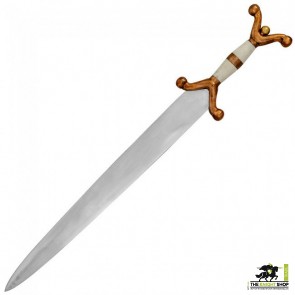

Celtic Sword
The Celts were a group of tribal societies in Iron Age and Medieval Europe. They settled in Britain in around 500 BC and flourished until the Romans invaded in 55 BC. The most famous Celtic Queen was Boudicca, Queen of the Iceni Tribe. She attacked London in AD 60 but was eventually defeated in battle.
The Celtic Sword features and anthropomorphic hilt - the human form must have been intended to enhance the power of the owner and to bear a talismanic significance. The British Museum has some excellent examples of this style of sword in their collection.
This replica is of a type associated with the La Tène culture, named after the important Celtic site on Lake Neuchâtel in present-day Switzerland and eastern France. It features a polished bronze hilt with bone grip - both associated with high status. The blade is hand forged from steel and is housed in a hand stitched leather scabbard. This item has a blunt blade and is manufactured for display only.
Total Length: 62cm
Blade Length: 46cm
Grip Length: 8cm
Weight: 1050g
Blade Thickness (base): 0.5cm
Blade Width (base): 4.7cm
Point of Balance (PoB): 6cm
Blade: EN45 High Carbon Steel
Edge: Blunt
Pommel: Nut
Scabbard: Leather
All dimensions are approximate and may vary from piece to piece.Buy the Celtic sword with confidence from the UK’s leading Celtic sword retailer.
Learn More -


Spartan Sword with Baldric
Our Spartan Sword is inspired by those wielded by the hoplites in King Leonidas’s army when defending the Hot Gates against attack from the Persian Army.
It features a blackened solid steel guard and leather wrapped grip. The blade is forged from steel and is designed for hacking and slashing. It comes complete with a leather scabbard and baldric strap designed to be worn over the shoulder.
This sword features a blunt blade and is designed for display only.
Overall Length: 69cm
Blade Length: 53cm
Grip length: 11cm
Weight: 1314g
Blade width (base): 3.5cm
Blade: EN45 High Carbon Steel
Edge: Blunt
Pommel: Peened
Scabbard: Leather
All dimensions are approximate and may vary from piece to piece.Buy the Spartan Sword with confidence from the UK’s leading Greek sword retailer.
Learn More -


Roman Mainz Gladius
The Roman Gladius was the primary weapon of the Roman Legionary and was used in conjunction with the 'Scutum' (shield) and 'Pilum' (spear). Its design was strongly influenced by the swords used by the Iberian (Spanish) Celts. It was predominantly designed as a thrusting weapon and was in use in one form or another from the 4th Century BC to the 3rd Century AD.
This sword ("gladius" in Latin) found in Mainz, Germany has a leaf-shaped, double-edged blade. It was as effective for cuts as it was for thrusts, which means it was the perfect sword for close combat. The bone grip is characteristic of this type of gladius and the guard prevents your hand from slipping onto the blade after a strong thrust. The ample pommel keeps your hand on the grip after strong cuts. A scabbard with ornamental brass applications comes with this Mainz type gladius.Our Roman Mainz Gladius features a turned wood pommel and bone grip. The straight blade is hand forged from steel and is housed in a wooden scabbard with red leather covering and decorated brass fittings.
This sword is not designed or recommended for contact reenactment (fighting) but is favoured by living history enthusiasts.
Overall Length: 72cm
Blade Length: 54cm
Blade Width: 6.5cm
Blade Thickness: 0.5cm
Weight: 818g
Material: EN45 High Carbon Steel
Edge: Blunt
Pommel: Nut
Scabbard: Wood, Leather, Brass
All dimensions are approximate and may vary from piece to piece.Buy the Roman Mainz Gladius with confidence from the UK’s leading Roman sword retailer.
Learn More -


Roman Legionary Pompeii Gladius
The Roman Gladius was the primary weapon of the Roman Legionary and was used in conjunction with the 'Scutum' (shield) and 'Pilum' (spear). Its design was strongly influenced by the swords used by the Iberian (Spanish) Celts. It was predominantly designed as a thrusting weapon and was in use in one form or another from the 4th Century BC to the 3rd Century AD.
The Pompeii Gladius takes its name from the archaeological site in Italy where, during excavations, 4 such swords were found. The swords are dated to before 79AD - the year that Pompeii was buried in volcanic ash. The Pompeii Gladius, along with the earlier Mainz Pattern Gladius, would have been issued to the garrison at Hadrian’s Wall. Examples can be seen in H. Russell Robinson’s book "What The Soldiers Wore On Hadrians Wall'".
Our Pompeii Gladius features a turned wood pommel and bone grip. The straight blade is hand forged from steel and housed in a wooden scabbard with red leather covering and brass fittings.
This sword is not designed or recommended for contact reenactment (fighting) but is favoured by living history enthusiasts.
Total Length: 76cm
Blade Length: 49cm
Scabbard: Wood and Leather
All dimensions are approximate and may vary from piece to piece.Buy the Roman Legionary Pompeii Gladius with confidence from the UK’s leading Roman sword retailer.
Learn More -

Roman Pompeii Gladius - Decorated
The Roman Gladius was the primary weapon of the Roman Legionary and was used in conjunction with the 'Scutum' (shield) and 'Pilum' (spear). Its design was strongly influenced by the swords used by the Iberian (Spanish) Celts. It was predominantly designed as a thrusting weapon and was in use in one form or another from the 4th Century BC to the 3rd Century AD.
The Pompeii Gladius takes its name from the archaeological site in Italy where, during excavations, 4 such swords were found. The swords are dated to before 79AD - the year that Pompeii was buried in volcanic ash. The Pompeii Gladius, along with the earlier Mainz Pattern Gladius, would have been issued to the garrison at Hadrian’s Wall. Examples can be seen in H. Russell Robinson’s book "What The Soldiers Wore On Hadrians Wall'".
Our Pompeii Gladius features a turned wood pommel and bone grip. The straight blade is hand forged from steel and in housed in a wooden scabbard with red leather covering and decorated brass fittings. This sword is not designed or recommended for contact reenactment (fighting) but is favoured by living history enthusiasts.
Overall Length: 70cm
Blade Length: 48cm
Width: 4.9cm
Grip Length: 10.8cm
Weight: 1135g
Thickness: 5mm
P.O.B: 11cm
Edge: Blunt
Pommel: Threaded
Scabbard: Wood, Leather, Brass
All dimensions are approximate and may vary from piece to piece.Buy the Roman Pompeii Gladius – Decorated with confidence from the UK’s leading Roman sword retailer.
Learn More -
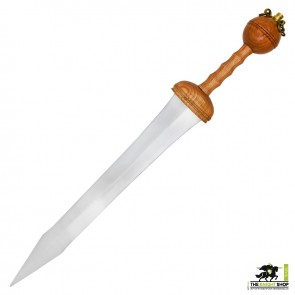
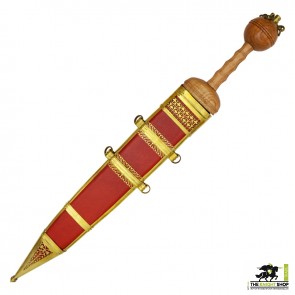
Dubrabica Roman Gladius
Step into the ranks of Roman military elite with the Dubravica Roman Gladius, a meticulously crafted reproduction based on a rare archaeological find near Dubravica in Eastern Europe. Unlike the standard legionary gladius, this extraordinary piece features a wooden pommel crowned with four brass rings, believed to denote rank or ceremonial significance.
Learn More
Crafted by Deepeeka, a global leader in historical replicas, this gladius brings together archaeological accuracy, craftsmanship, and heritage—ideal for discerning collectors, museums, and Roman reenactment specialists.
Blade Material: High Carbon Steel
Pommel Material: Hardwood with four bronze rings
Grip: Ribbed wooden handle
Scabbard: Ornate leather with brass detailing
Total Length: 76cm
Blade Length: 54.5cm
Blade Width: 6.5cm
Guard Width: 9cm
Grip Length: 10.5cm
P.O.B (from guard): 11cm
Edge: Blunt
All dimensions are approximate and may vary from piece to piece. -


Seax of Beagnoth
The Seax of Beagnoth (also known as the Thames scramasax) is a 9th century Anglo-Saxon seax (single-edged knife). It was found in the River Thames in 1857, and is now at the British Museum in London.
On one side of the blade is the only known complete inscription of the twenty-eight letter Anglo-Saxon runic alphabet, as well as the name "Beagnoth" in runic letters. It is thought that the runic alphabet had a magical function, and that the name Beagnoth is that of either the owner of the weapon or the smith who forged it.
Although many Anglo-Saxon and Viking swords and knives have inscriptions in the Latin alphabet on their blades, or have runic inscriptions on the hilt or scabbard, the Seax of Beagnoth is one of only a handful of finds with a runic inscription on its blade.Our faithful replica is based on the dimensions of the original and has a hand forged steel blade with wood grip and hand crafted leather scabbard.
Total length: 73.5cm
Blade length: 55.5cm
Grip length: 18cm
Weight: 906g
Blade width (base): 4.3cm
Blade: EN45 High Carbon Steel
Edge: Blunt
Scabbard: Stitched Leather
All dimensions are approximate and may vary from piece to piece.Buy the Seax of Beagnoth with confidence from the UK’s leading Viking sword retailer.
Learn More -


Isle of Eigg Viking Sword
The hilt of the Isle of Eigg Sword is the finest example of a Viking sword hilt ever found in Scotland and currently resides on the National Museums of Scotland collection. It was discovered on the island of Eigg in the Inner Hebrides by a local farmer whilst levelling a mound. The mound is thought to have contained a pagan burial and also contained bronze bucket mounts, a whetstone and some pieces of the original blade.
The sword dates from around the 9th or 10th century. All parts of the hilt are richly decorated animal and geometric ornament in panels. Some of the original decoration was inlaid with silver or silver thread.
Our illustration picture is taken from 'Scottish Notes and Queries, vol.3. 1889-1890’.
Our Isle of Eigg Sword replica features a double-edged blade with wide central fuller. The grip, guard and pommel are made of cast bronze. The unsharpened blade is made of well-tempered mild steel and is peened at the pommel for durability. It comes complete with a leather-wrapped wooden scabbard with similar bronze fittings.
Total Length: 97.5cm
Learn More
Blade Length: 80cm
Blade Width: 5cm
Grip Length: 17.5cm
Weight: 2kg
Blade: EN45 High Carbon Steel
Edge: Blunt
Pommel: Peened
Scabbard: Wood, Leather, Brass
All dimensions are approximate and may vary from piece to piece.