





Sword Brands
-


Colada Cid Cadet Sword - Forged
The COLADA is one of the two swords, together with the Tizona, that legendary tradition attributes to the Cid, until he gave them to his sons-in-law, the Infantes de Carrión. The sword had been won in combat by the Burgos warrior from the Count of Barcelona and, although it was given, together with the Tizona, to his sons-in-law the Infantes, it was returned by them after the affront committed against their daughters, Doña Elvira and Doña Sol in the town of Corpes and which gave rise to the name of the affront narrated by the song of Mío Cid.
Learn More
After the incident, El Cid had been disgraced and asked the king for justice. The trial culminates with the "riepto" or duel in which the representatives of the cause of the Cid defeat the infants. These are dishonored in a public joust and their weddings are annulled, also returning the swords. Colada being given again by the Cid to his knight Martín Antolínez. Historians also doubt that the one kept in the Royal Palace of Madrid and shown as the royal Colada sword is indeed the authentic one.
Total Length: 75cm
Blade: Stainless Steel
Edge: Blunt
Scabbard: None
All dimensions are approximate and may vary from piece to piece. -

Colada Cid Cadet Sword - Brass
The COLADA is one of the two swords, together with the Tizona, that legendary tradition attributes to the Cid, until he gave them to his sons-in-law, the Infantes de Carrión. The sword had been won in combat by the Burgos warrior from the Count of Barcelona and, although it was given, together with the Tizona, to his sons-in-law the Infantes, it was returned by them after the affront committed against their daughters, Doña Elvira and Doña Sol in the town of Corpes and which gave rise to the name of the affront narrated by the song of Mío Cid.
Learn More
After the incident, El Cid had been disgraced and asked the king for justice. The trial culminates with the "riepto" or duel in which the representatives of the cause of the Cid defeat the infants. These are dishonored in a public joust and their weddings are annulled, also returning the swords. Colada being given again by the Cid to his knight Martín Antolínez. Historians also doubt that the one kept in the Royal Palace of Madrid and shown as the royal Colada sword is indeed the authentic one.
Total Length: 75cm
Blade: Stainless Steel
Edge: Blunt
Scabbard: None
All dimensions are approximate and may vary from piece to piece. -

Great Captain Cadet Sword - Forged
Gonzalo Fernández de Córdoba was a Spanish general who fought in the Conquest of Granada and the Italian Wars. He reorganized the emerging Spanish army and its tactics, and was regarded as the "father of trench warfare". He was also called "The Great Captain".
Learn More
Córdoba was a pioneer of modern warfare. As a field commander, like Napoleon three centuries later, his goal was the destruction of the enemy army. Córdoba systematically pursued defeated armies after a victory to minimize future resistance. He helped found the first modern standing army (the nearly-invincible Spanish infantry which dominated European battlefields for most of the 16th and 17th centuries).
Total Length: 75cm
Blade: Stainless Steel
Edge: Blunt
Scabbard: None
All dimensions are approximate and may vary from piece to piece. -

Great Captain Cadet Sword - Brass
Gonzalo Fernández de Córdoba was a Spanish general who fought in the Conquest of Granada and the Italian Wars. He reorganized the emerging Spanish army and its tactics, and was regarded as the "father of trench warfare". He was also called "The Great Captain".
Learn More
Córdoba was a pioneer of modern warfare. As a field commander, like Napoleon three centuries later, his goal was the destruction of the enemy army. Córdoba systematically pursued defeated armies after a victory to minimize future resistance. He helped found the first modern standing army (the nearly-invincible Spanish infantry which dominated European battlefields for most of the 16th and 17th centuries).
Total Length: 75cm
Blade: Stainless Steel
Edge: Blunt
Scabbard: None
All dimensions are approximate and may vary from piece to piece. -

Tizona Cid Cadet Sword - Forged
The Tizona is one of the two swords, along with the Casting , the legendary tradition attributed to the Cid, until it gave to his sons-in-law the Infantes of Carrión. The sword had been won in combat by the warrior Catalan Count of Barcelona and, despite the fact that it was given, along with Tizona, your sons-in-law the Infantes, the same was returned by them after the outrage committed on his daughters doña Elvira and Doña Sol in the town of Corpes, and that gave rise to the name of the reproach that tells the cantar de mio Cid.
Learn More
After the incident, The Cid had been disgraced and calls for justice to the king. The trial culminates with the "riepto" or duel in which the representatives of the cause of the Cid are due to the infants. They are disgraced in fair public and nullify their wedding returning also the swords. Being Cast given again by the Cid to his knight Martín Antolínez. Historians also doubt that the guarded in the Royal Palace of Madrid and shown as the sword Colada real is in fact authentic.
Total length: 75cm
Blade: Stainless Steel
Edge: Blunt
Scabbard: None
All dimensions are approximate and may vary from piece to piece. -

Tizona Cid Cadet Sword - Brass
The Tizona is one of the two swords, along with the Casting , the legendary tradition attributed to the Cid, until it gave to his sons-in-law the Infantes of Carrión. The sword had been won in combat by the warrior Catalan Count of Barcelona and, despite the fact that it was given, along with Tizona, your sons-in-law the Infantes, the same was returned by them after the outrage committed on his daughters doña Elvira and Doña Sol in the town of Corpes, and that gave rise to the name of the reproach that tells the cantar de mio Cid.
Learn More
After the incident, The Cid had been disgraced and calls for justice to the king. The trial culminates with the "riepto" or duel in which the representatives of the cause of the Cid are due to the infants. They are disgraced in fair public and nullify their wedding returning also the swords. Being Cast given again by the Cid to his knight Martín Antolínez. Historians also doubt that the guarded in the Royal Palace of Madrid and shown as the sword Colada real is in fact authentic.
Total Length: 75cm
Blade: Stainless Steel
Edge: Blunt
Scabbard: None
All dimensions are approximate and may vary from piece to piece. -

Great Captain Sword
Our Great Captain Sword by Marto embodies the story that begins with Gonzalo Ferdinaz de Cordoba, a great military leader in the time of the Catholic Kings (15th and 16th centuries). He got his first victories during the Granada conquest. Later, he distinguished himself in the campaigns to Naples and Sicily.
Learn More
Called "The Great Captain", he created the army that was the base of the Spanish military power during the 16th century.
Total Length: 75cm
Blade: Stainless Steel
Edge: Blunt
Scabbard: None
All dimensions are approximate and may vary from piece to piece. -


Black Prince Sword
Edward of Woodstock (1330 –1376), called the Black Prince, was the eldest son of King Edward III and Philippa of Hainault, and the father of King Richard II of England. He was the first Duke of Cornwall, the Prince of Wales, and the Prince of Aquitaine.
Learn More
He was called "Edward of Woodstock" in his early life, after his birthplace, and since the 16th century has been popularly known as the Black Prince. The "Black Prince": The origins of the name are uncertain, that it is derived from Edward's black shield, and/or his black armour or that it is derived from Edward's brutal reputation, particularly towards the French in Aquitaine. He was an exceptional military leader, and his victories over the French at the Battles of Crécy and Poitiers made him very popular during his lifetime. In 1348 he became the first Knight of the Garter, of whose order he was one of the founders.
Edward died one year before his father, becoming the first English Prince of Wales not to become King of England. The throne passed instead to his son Richard II, a minor, upon the death of Edward III.
Total Length: 118cm
Blade Length: 89cm
Blade Width: 5.5cm
Grip Length: 20cm
Guard Width: 25cm
P.O.B (from guard): 12cm
Weight: 2.6kg
Material: Stainless Steel
Edge: Blunt
Scabbard: None
All dimensions are approximate and may vary from piece to piece. -

Arabian Alfanje
There were given various shapes to these cutlasses in past times and there was an important Toledo production of them during the Arabic invasion. A sample of these cutlasses can be found in the “Museo del Ejercito” in Madrid.
Learn More
Its main characteristics are the cross-ward, which raises to the handle on one side and descends to the blade on the other side, and its wide and curved blade. This stylized cutlass of our production shows all these characteristics, remembering that Toledo was an important center of sword production also during its Arab period.
Total Length: 84cm
Total Width: 15cm
Weight: 2.8kg
Blade: Stainless Steel
Edge: Blunt
All dimensions are approximate and may vary from piece to piece. -
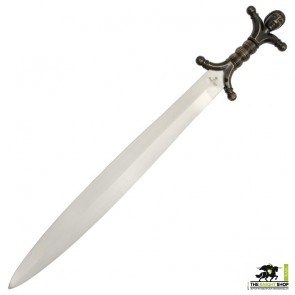
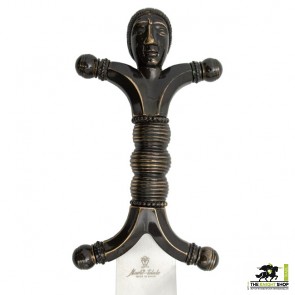
North Grimston Celtic Sword
In 1902, workers accidentally found a Celtic grave on the North Grimston estate. The Celt was buried with a shield, two swords, and a piece of pork. The smallest sword was decorated with an anthropomorphic grip (shaped like a human), typical for Celtic swords from the La Tene period. Such swords were luxurious and exclusive and belonged to mighty warriors.
Learn More
Similar swords have been excavated in Switzerland, Hungary, France, and other Celtic countries. The original sword is now on display at the Hull and East Riding Museum and is one of the best-preserved anthropomorphic swords. This Celtic ornamental sword is great for collectors of historical swords and as home decoration.
Total Length: 63cm
Weight: 1050g
Blade: AISI 420 Stainless Steel
Edge: Blunt
Scabbard: None
All dimensions are approximate and may vary from piece to piece.