





Sword Brands
-


El Cid Broadsword
This Spanish ceremonial Broadsword is characterized by branched hilt arms curved towards the blade like a floral corolla. A double-edged blade with a rhomboidal section and wide under the hilt for cutting rather than thrusting.
Learn More
Total Length: 104cm
Weight: 957g
Blade: Stainless Steel
Edge: Unsharpened
Scabbard: None
All dimensions are approximate and may vary from piece to piece. -


Ferdinand III Sword
One of the greatest figures in European History was Ferdinando Alfonso. Known as the Saint, and the "king of the three religions" because of the harmony he had managed to create between Christians, Jews, and Muslims. He was king of Castile (1217-1252) and of Leòn (1230-1252) with the title of Ferdinand III, and the main architect of the "Reconquista" of the Catholic kings of the Iberian territories under Muslim control.
Learn More
This is a reproduction of the sword that belonged to the great king Ferdinand III and his son Alfonso IX, and is now kept in the Royal Armory of Madrid.
Total Length: 124cm
Weight: 957g
Blade: Stainless Steel
Edge: Unsharpened
Scabbard: None
All dimensions are approximate and may vary from piece to piece. -


Side Sword - 17th Century
The 'spada da lato' or side-sword is a type of sword popular during the late 16th century. It is a continuation of the medieval arming sword, and the immediate predecessor of the rapier of the Early Modern period.
Learn More
Two-edged blade and steel point with hexagonal section. Brass-plated metal, finely chiseled with figures and foliage, slightly recessed straight arms of the guard and arched bridge to protect the knuckles.
Total Length: 103cm
Weight: 957g
Blade: Stainless Steel
Edge: Unsharpened
Scabbard: None
All dimensions are approximate and may vary from piece to piece. -


Italian Smallsword - 18th Century
An Italian smallsword of the eighteenth century, probably of Venetian origin. The double-edged and pointed blade is made of steel. This is a light one-handed sword designed for thrusting which evolved out of the longer and heavier rapier of the late Renaissance.
Learn More
The height of the small sword's popularity was between the mid 17th and late 18th century, when any man, civilian or military, with pretensions to gentlemanly status would have worn a small sword on a daily basis.
Total Length: 106cm
Weight: 957g
Blade: Stainless Steel
Edge: Unsharpened
Scabbard: None
All dimensions are approximate and may vary from piece to piece. -


Dragon Hilt Smallsword
This Italian sword dates back to the first half of the nineteenth century where it was worn on the occasion of parades and ceremonies. A similar sword belonged to the Swedish General Gustaf Wilhelm Tibell.
Learn More
The double-edged and pointed blade is made of steel. The brass-plated metal hilt has a handle that is shaped like the head of a dragon, as well as the bridge protecting the knuckles which has the shape of a gothic-style griffin.
Total Length: 104cm
Weight: 957g
Blade: Stainless Steel
Edge: Blunt
Scabbard: None
All dimensions are approximate and may vary from piece to piece. -


Ceremonial Sword - 16th Century
Smallsword of the sixteenth century, carried by officers as a service weapon.
Learn More
The blade, made of steel with two edges and a tip, is similar to a rapier. The brass-plated metal has a guard with straight arms with the ends as small crosses, an open handle, and a pommel sculpted like a plume.
Total Length: 104cm
Weight: 957g
Blade: Stainless Steel
Edge: Unsharpened
Scabbard: None
All dimensions are approximate and may vary from piece to piece. -
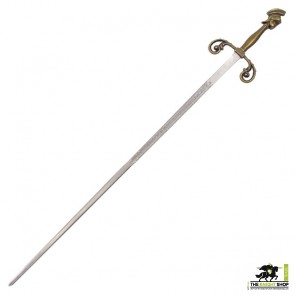
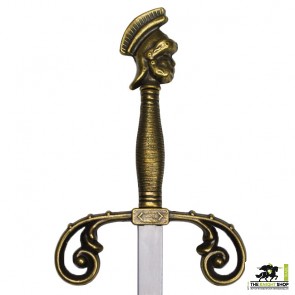
Italian Smallsword - 19th Century
A sword of this type belonged to Ferdinand I, King of the Two Sicilies. The blade is made of steel with two edges and a hexagonal section tip. This is a light one-handed sword designed for thrusting which evolved out of the longer and heavier rapier of the late Renaissance.
Learn More
The height of the small sword's popularity was between the mid 17th and late 18th century, when any man, civilian or military, with pretensions to gentlemanly status would have worn a small sword on a daily basis.
Total Length: 106cm
Weight: 957g
Blade: Stainless Steel
Edge: Unsharpened
Scabbard: None
All dimensions are approximate and may vary from piece to piece. -


Medieval Arming Sword - 13th Century
Ferdinand III conquered Andalusia and imposed tribute on the remaining Muslim states in Spain—Murcia, and Granada.
Learn More
This sword is a reproduction based on the original sword preserved in the Royal Armory of Madrid. The double-edged and pointed blade is made of steel, with a hexagonal section. The brass-plated metal is finely chiseled with geometric beehive figures on the guard and hilt. The spindle handle culminates in a five-lobed pommel, while the arms are wound in a spiral, ending in ivy leaves.
Total Length: 106cm
Weight: 957g
Blade: Stainless Steel
Edge: Unsharpened
Scabbard: None
All dimensions are approximate and may vary from piece to piece. -


El Cid “Tizona “ Sword
This Spanish ceremonial sword is characterized by branched hilt arms curved towards the blade like a floral corolla. The two-edged blade is made of steel and has a hexagonal section, while the hilt is in cast brass-plated metal with a spindle handle.
Learn More
Total Length: 105cm
Weight: 500g
Blade: Stainless Steel
Edge: Unsharpened
Scabbard: None
All dimensions are approximate and may vary from piece to piece. -


Display Plaque & El Cid "Tizona" Sword
This Spanish ceremonial sword is characterized by branched hilt arms curved towards the blade like a floral corolla. The two-edged blade is made of steel and has a hexagonal section, while the hilt is in cast brass-plated metal with a spindle handle.
Learn More
The shaped, wooden display plaque is equipped with an eyelet for hanging on the wall.
Sword:
Total Length: 105cm
Weight: 500g
Blade: Stainless Steel
Edge: Blunt
Scabbard: None
Plaque:
Length: 112cm
Width: 16cm
Weight: 970g
All dimensions are approximate and may vary from piece to piece.