





Sword Brands
-


British Royal Artillery Gunner's Sword
This replica of the British Royal Artillery Gunners Sword has a blade forged from 1055 high carbon steel; replicated at the base of the spine are the manufacturer's markings as seen on an original example (DAWES BIRMM – William and Samuel Dawes of Birmingham). The hilt is crafted from brass and the wooden grip is bound in black leather. The sword is paired with a leather scabbard complete with a brass chape and locket.
Learn More
This British Royal Artillery Sword was the sidearm of British Artillery crews in the early 1800s and these swords saw action in the Peninsular War, Waterloo, and the War of 1812. Unique for its wide and straight-bladed design, the sword was likely inspired by the French Imperial Guard Infantry Sword. The United States would borrow heavily from the design of this British sword when creating their own US Light Artilleryman's Saber during the War of 1812 which essentially was a marginally modified hilt design coupled with a curved saber blade.
Total Length: 78cm
Blade Length: 64cm
Handle Length: 11cm
Weight: 1270g
Blade Steel: 1055 High Carbon Steel
Blade Edge: Blunt
All dimensions are approximate and may vary from piece to piece. -


Russo Japanese Officer Sabre
This reproduction of a Russo-Japanese Kyu Gunto military saber has a blade of tempered high carbon steel which is durably mounted into a hilt of brass with a leather-bound wooden grip. Bands of copper wire inlay and a button-activated locking mechanism that secures the hilt to the scabbard. Included is a steel scabbard with a steel hanging ring.
Learn More
Total Length: 81cm
Blade Length: 65cm
Blade Thickness: 5mm - 6.2mm
Weight: 907g
Blade Steel: EN9 High Carbon Steel
Blade Edge: Blunt
All dimensions are approximate and may vary from piece to piece. -
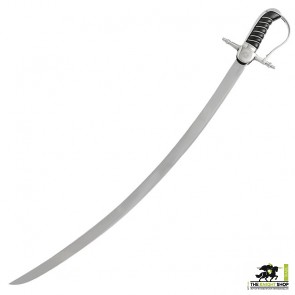
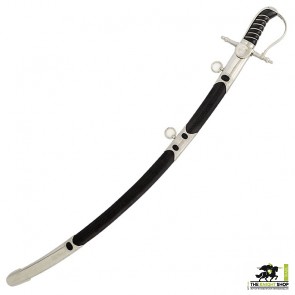
95th Rifles Regimental Sabre - 1803 Pattern
This sword is a must for fans of Bernard Cornwell’s “Sharpe”! Army regulations specified that the swords for officers of the Rifle Corps was to be ‘a sabre similar to the Light Cavalry’. The 1796 sabre was clearly too long and the result was the 1803 Pattern Regimental Sabre.
Learn More
This sword is based on an original in the National Army Museum. The original blade has faded evidence of complex etching, this has not been replicated on our tempered AISI 1065 high carbon steel blade. The brass, nickel-plated hilt features a wood grip wrapped in black leather with a steel wire overlay. It is also etched with the number 95, alluding to the 95th Rifles Regiment. The pure buff hardened leather scabbard has steel fittings and suspension rings. It is based on a watercolour print from 1812 showing an officer of the 95th wearing a scabbard of this configuration.
Total Length: 94cm
Blade Length: 80cm
Grip Length: 9.5 cm
Weight: 1176g
Blade Thickness (base): 0.5cm
Blade Width (base): 3cm
Point of Balance (PoB): 18cm
Blade: AISI 1065 High Carbon Steel
Edge: Blunt
Pommel: Nut
Scabbard: Leather, Steel
All dimensions are approximate and may vary from piece to piece. -


Infantryman's Hanger Cutlass
This reproduction of a British infantrymans hanger is based on an extant example dating to 1760. These British brass-hilted swords were heavily influenced by French and German hangers from the continent as evidenced by its half-basket hilt with a heart shaped guard. The hanger sword is designed for close-in fighting – the blade is an ideal length for a close-quarters scrum.
Learn More
This Hanger sword has a blade of 1055 high carbon steel peened to a hilt of brass. Its companion scabbard is crafted from sturdy leather with chape and throat pieces of brass.
Total Length: 78cm
Blade Length: 65cm
Grip Length: 9.5cm
Weight: 907g
Blade Thickness (base): 5.4mm-3.1mm
Blade Width (base): 36mm
Point of Balance (PoB): 14cm
Blade: AISI 1065 High Carbon Steel
Edge: Blunt
Pommel: Peened
Scabbard: Leather, Wood, Brass
All dimensions are approximate and may vary from piece to piece. -


British Infantry Officer's Sword - GR 1897 Pattern (Leather Scabbard)
This sword is considered by some to be the best fighting sword ever issued to a British Officer. As such it has never been replaced and is the current issue sword within the British Army. The only difference between this sword and its Victorian predecessor is the cypher of the reigning monarch at the time of issue.
Learn More
The polished blade has been forged from AISI 1065 High Carbon Steel and has been well tempered. Includes regulation pattern leather scabbard.
Replacement steel scabbard and leather scabbard available separately.
Total Length: 98cm
Blade Length: 82.5cm
Grip Length: 10.5cm
Weight: 0.902kg
Blade Thickness (base): 5.6mm
Blade Thickness (CoP): 4.7mm
Blade Width (base): 2.3cm
Blade Width (CoP): 2cm
Point of Balance (PoB): 14cm
Centre of Percussion (CoP): 26cm
Blade: AISI 1065 High Carbon Steel
Edge: Blunt
Pommel: Nut
Scabbard: Leather, Wood, Steel
All dimensions are approximate and may vary from piece to piece. -


British Infantry Officer's Sword - GR 1897 Pattern (Steel Scabbard)
This sword is considered by some to be the best fighting sword ever issued to a British Officer. As such it has never been replaced and is the current issue sword within the British Army. The only difference between this sword and its Victorian predecessor is the cypher of the reigning monarch at the time of issue.
Learn More
The polished blade has been forged from AISI 1065 High Carbon Steel and has been well tempered.
Replacement steel scabbard and leather scabbard available separately.
Total Length: 98cm
Blade Length: 82.5cm
Grip Length: 10.5cm
Weight: 0.902kg
Blade Thickness (base): 5.6mm
Blade Thickness (CoP): 4.7mm
Blade Width (base): 2.3cm
Blade Width (CoP): 2cm
Point of Balance (PoB): 14cm
Centre of Percussion (CoP): 26cm
Blade: AISI 1065 High Carbon Steel
Edge: Blunt
Pommel: Nut
Scabbard: Steel, Leather
All dimensions are approximate and may vary from piece to piece. -


British Royal Navy Officer's Sword - (Pipe-Backed) 1827 Pattern
This sword was first introduced to the Royal Navy in 1827 and has been standard issue throughout a multitude of conflicts since. It is still the regulation pattern sword to this day.
Learn More
This version features a pipe-backed blade that went out of regulation in 1846. Its design was adopted and is carried today by countries within the Commonwealth such as the Canadian and Royal Australian Navy. The polished blade has been forged from AISI 1065 High Carbon Steel and has been well tempered.
Total Length: 93.5cm
Blade Length: 80cm
Grip Length: 9.5cm
Weight: 0.814kg
Blade Thickness (base): 5.1mm
Blade Width (base): 2.9cm
Point of Balance (PoB): 16cm
Blade: AISI 1065 High Carbon Steel
Edge: Blunt
Pommel: Peened
Scabbard: Leather, Wood, Brass
All dimensions are approximate and may vary from piece to piece. -


British Infantry Officer's Sword - ER 1897 Pattern (Steel Scabbard)
This sword is considered by some to be the best fighting sword ever issued to a British Officer. As such it has never been replaced and is the current issue sword within the British Army. The only difference between this sword and its Victorian predecessor is the cypher of the reigning monarch at the time of issue. The polished blade has been forged from AISI 1065 High Carbon Steel and has been well tempered.
Learn More
Scabbard included. Replacement steel scabbard and leather scabbard available separately.
Total Length: 98cm
Blade Length: 82.5cm
Grip Length: 10.5cm
Weight: 0.902kg
Blade Thickness (base): 5.6mm
Blade Thickness (CoP): 4.7mm
Blade Width (base): 2.3cm
Blade Width (CoP): 2cm
Point of Balance (PoB): 14cm
Centre of Percussion (CoP): 26cm
Blade: AISI 1065 High Carbon Steel
Edge: Blunt
Pommel: Nut
Scabbard: Steel
All dimensions are approximate and may vary from piece to piece. -
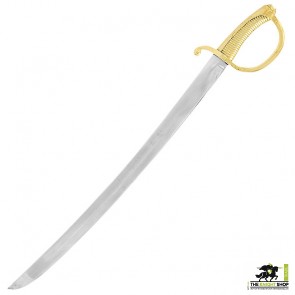
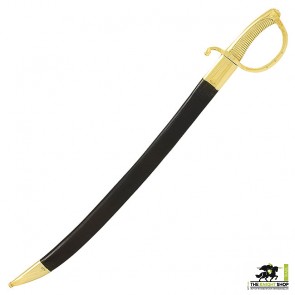
French Briquet Cutlass
This sword is very popular with people studying cutlass drills and was carried by most of the French Infantry throughout the Napoleonic Wars. It is also very popular for opening champagne bottles!
Learn More
The polished blade has been forged from EN9 steel and has been well tempered.
Total Length: 74cm
Blade Length: 60cm
Grip Length: 10cm
Weight: 1.012kg
Blade Thickness (base): 7.2mm
Blade Width (base): 3.4cm
Point of Balance (PoB): 11cm
Blade: High Carbon Steel
Edge: Blunt
Pommel: Peened
Scabbard: Leather, Wood, Brass
All dimensions are approximate and may vary from piece to piece. -
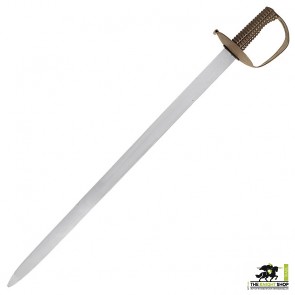
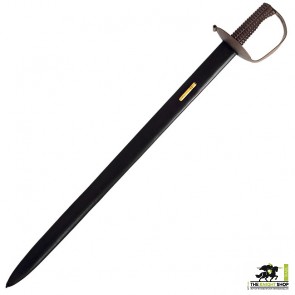
British Royal Navy Boarding Cutlass - 1804 Pattern
This pattern of sword was introduced during the Napoleonic Wars and saw service at the famous Battle of Trafalgar. Previous cutlasses shared a similar figure 8 hilt design but featured horn or leather grips that deteriorated quickly when exposed to seawater and changes in temperature.
Learn More
The introduction of an iron grip greatly extended the serviceable life of this sword. The hilts were traditionally painted or japanned to stop them from rusting. The blade has been forged from AISI 1065 High Carbon Steel and has been well-tempered. It is housed in a black hardened buff leather scabbard.
Total Length: 89cm
Blade Length: 74.5cm
Grip Length: 12cm
Weight: 1.458kg
Blade Thickness (base): 6.3mm
Blade Width (base): 3.6cm
Point of Balance (PoB): 15cm
Blade: AISI 1065 High Carbon Steel
Edge: Blunt
Pommel: Threaded
Scabbard: Leather, Brass
All dimensions are approximate and may vary from piece to piece.