





Sword Brands
-
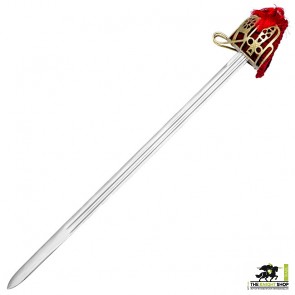

Jacobite Basket Hilt Sword
The iconic Basket Hilt Sword was wielded by Jacobite warriors during the rebellions of 1715 and 1745. It was usually partnered with the Scottish targe shield and was used to devastating effect during the Highland Charge! After the rebellion had been suppressed, the wearing of Scottish Basket Hilt swords, synonymous with Highland dress, was outlawed. However, the sword was adopted by officers of the Highland regiments in the 19th century.
Learn More
Our Jacobite Basket Hilt Sword features a brass basket with red cloth lining. The hand forged high carbon steel blade has a blunt edge and is housed in a leather covered wood scabbard.
Total Length: 106cm
Blade Length: 89cm
Grip Length: 11cm
Weight: 1600g
Blade Thickness (base): 0.5cm
Blade Width (base): 3.6cm
Point of Balance (PoB): 20cm
Blade: High Carbon Steel
Edge: Blunt
Pommel: Threaded
Scabbard: Leather, Wood, Brass
All dimensions are approximate and may vary from piece to piece. -


William Wallace Braveheart Sword - Brass
Our William Wallace Braveheart Sword is inspired by the sword used in the film Braveheart.
Learn More
It is forged from high carbon steel and features a broad blade topped with solid brass hilt fittings and a brown suede ricasso and grip. This sword features a blunt blade and is designed for display only.
Total Length: 136cm
Blade Length: 97.5cm
Grip Length: 28.6cm
Weight: 2.1kg
Blade Width (base): 4.3cm
Point of Balance (PoB): 14cm
Blade: High Carbon Steel
Edge: Blunt
Pommel: Threaded
Scabbard: None
All dimensions are approximate and may vary from piece to piece. -


Red Dragon - Oakeshott XIV Sword
Our Oakeshott XIV Sword is a replica of an original that is currently on display in the Metropolitan Museum of Art, New York.
Learn More
Oakeshott describes it as being “an absolutely outstanding sword, not only because of its condition but by reason of its splendid proportions and great size. It dates from around the first quarter of the 14th century and is remarkably similar to sword found on the body of Sancho IV el Bravo of Castile in Toledo Cathedral.
Total Length: 86cm
Blade Length: 68cm
Blade Width: 6.5cm
Blade Thickness: 0.45cm
Guard Width: 22cm
Point of Balance: 6cm
Weight: 1.3kg
Material: High Carbon Steel Blade, Leather Grip
Edge: Blunt
Scabbard: Wood, leather, steel
All dimensions are approximate and may vary from piece to piece. -
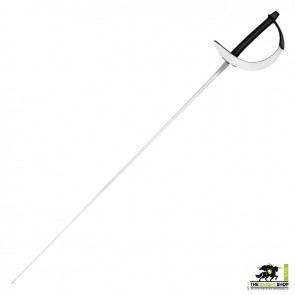

Red Dragon Stage Combat Sabre
Our Red Dragon Stage Combat Sabre is the perfect starter weapon for stage combat and theatrical work. The durable bowl style hilt protects the hands from stray blows, whilst the flexible high carbon steel blade features a rolled tip for added safety.
Learn More
The blade can be removed easily by unscrewing the pommel, great for transportation or maintenance.
Total Length: 103cm
Blade Length: 87cm
Grip Length: 13cm
Weight: 296g
Blade Thickness (base): 0.7cm
Blade Width (base): 1.1cm
Point of Balance (PoB): 10cm
Blade: High Carbon Steel
Edge: Blunt
Pommel: Threaded
Scabbard: None
All dimensions are approximate and may vary from piece to piece. -


Renaissance Rapier
The rapier began to develop at around the turn of the 15th century as the Spanish espada ropera, or "dress sword". It was a fast and light single handed sword designed for cutting and thrusting. In 1570 the Italian swordmaster Signior Rocco Bonetti settled in England and advocated the use of the rapier for thrusting as opposed to cutting when engaged in a duel. Although it was generally seen as a civilian weapon, more robust versions such as the Pappenheimer Rapier were developed for battlefield use and saw service in conflicts such as the English Civil War. Many rapier treatises still survive including "The Schoole of the Noble and Worthy Science of Defence" written in England in 1617 by Joseph Swetnam.
Learn More
Our Renaissance Rapier features a hand forged complex hilt constructed from steel and polished to a bright finish. The wire-bound handle is both attractive and functional - allowing for a firmer grip than the leather bound equivalent. The hand forged steel blade is housed in a well made wooden scabbard with leather covering and steel fittings. This sword is blunt and designed for display only.
Total Length: 100.5cm
Blade Length: 88.5cm
Grip Length: 18.5cm
Weight: 1702g
Blade Thickness (base): 4.82cm
Blade Width (base): 0.5cm
Point of Balance (PoB): 17cm
Blade: High Carbon Steel
Edge: Blunt
Pommel: Threaded
Scabbard: Leather, Wood, Steel
All dimensions are approximate and may vary from piece to piece. -
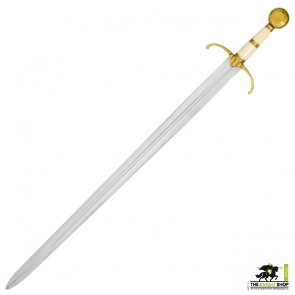
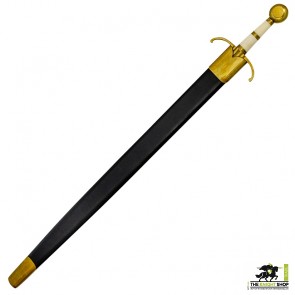
Blackfriars Sword
This Blackfriars Sword is inspired by a sword that was found in the mudbanks of the River Thames near Bull Wharf, Blackfriars. It is dated to around 1340-50 and is a typical knight's sword of the period. It is now held in the Royal Armouries collection.
Learn More
Our Blackfriars Sword has solid brass hilt fittings and a polished (camel) bone grip. The blade is hand forged from steel and is housed in a scabbard of leather covered wood with brass fittings. This item has a blunt blade and is manufactured for display only.
Matching dagger available in our Daggers section.
Total Length: 100cm
Blade Length: 83.5cm
Grip Length: 8.5cm
Weight: 1054g
Blade Thickness (base): 0.37cm
Blade Width (base): 4.2cm
Point of Balance (PoB): 23.5cm
Blade: High Carbon Steel
Edge: Blunt
Pommel: Peened
Scabbard: Leather, Wood, Brass
All dimensions are approximate and may vary from piece to piece. -


Seax of Beagnoth
On one side of the blade is the only known complete inscription of the twenty-eight letter Anglo-Saxon runic alphabet, as well as the name "Beagnoth" in runic letters. It is thought that the runic alphabet had a magical function, and that the name Beagnoth is that of either the owner of the weapon or the smith who forged it.
Learn More
Although many Anglo-Saxon and Viking swords and knives have inscriptions in the Latin alphabet on their blades, or have runic inscriptions on the hilt or scabbard, the Seax of Beagnoth is one of only a handful of finds with a runic inscription on its blade.
Total length: 73.5cm
Blade length: 55.5cm
Grip length: 18cm
Weight: 906g
Blade width (base): 4.3cm
Blade: EN45 High Carbon Steel
Edge: Blunt
Scabbard: Stitched Leather
All dimensions are approximate and may vary from piece to piece. -
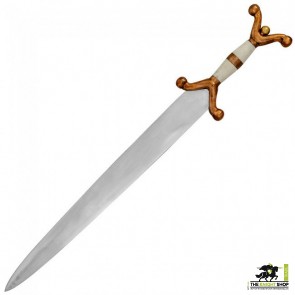

Celtic Sword
The Celtic Sword features and anthropomorphic hilt - the human form must have been intended to enhance the power of the owner and to bear a talismanic significance. The British Museum has some excellent examples of this style of sword in their collection.
Learn More
This replica is of a type associated with the La Tène culture, named after the important Celtic site on Lake Neuchâtel in present-day Switzerland and eastern France. It features a polished bronze hilt with bone grip - both associated with high status. The blade is hand forged from steel and is housed in a hand stitched leather scabbard. This item has a blunt blade and is manufactured for display only.
Total Length: 62cm
Blade Length: 46cm
Grip Length: 8cm
Weight: 1050g
Blade Thickness (base): 0.5cm
Blade Width (base): 4.7cm
Point of Balance (PoB): 6cm
Blade: EN45 High Carbon Steel
Edge: Blunt
Pommel: Nut
Scabbard: Leather
All dimensions are approximate and may vary from piece to piece. -
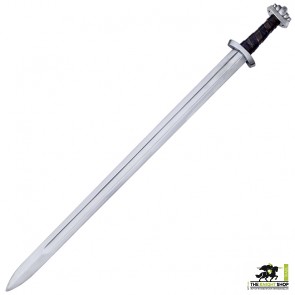
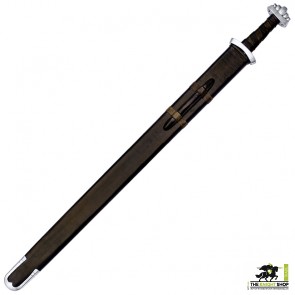
Five Lobe Viking Sword
Our 5 Lobe Viking Sword is based on a late Viking design from around the 11th century and is contemporary with the Battle of Stamford Bridge in 1066. A similar sword held in the British Museum collection was reputed to be taken from the tomb of the Earl of Pembroke in Temple Church, but was probably found in the River Thames at Temple Church.
Learn More
It features a forged and fullered steel blade designed for hacking and slashing and is hilted with a short guard and 5 lobed pommel. The wooden scabbard is wrapped with brown leather to match that of the leather wrapped sword grip. Although this sword has a forged blade it is not tempered and is not suitable for combat.
Total Length: 96cm
Blade Length: 78cm
Grip Length: 11cm
Weight: 1278g
Blade Thickness (base): 0.46cm
Blade Width (base): 4.45cm
Point of Balance (PoB): 16cm
Blade: EN45 High Carbon Steel
Edge: Blunt
Pommel: Peened
Scabbard: Wood, Leather
All dimensions are approximate and may vary from piece to piece. -
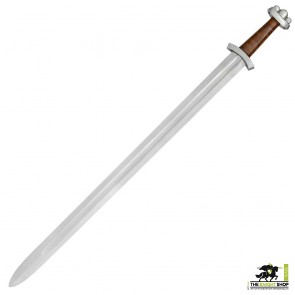
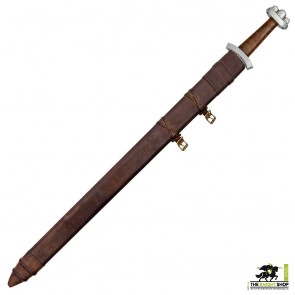
Three Lobe Viking Sword
Our 3 Lobe Viking Sword is based on a late Viking design from around the 11th century and is contemporary with the Battle of Stamford Bridge in 1066. A similar sword was found on Canwick Common in Norfolk and is now held in the British Museum collection.
Learn More
It features a forged and fullered steel blade designed for hacking and slashing and is hilted with a short guard and 3 lobed pommel. The wooden scabbard is wrapped with brown leather to match that of the leather wrapped sword grip. Although this sword has a forged blade it is not tempered and is not suitable for combat.
Total Length: 95cm
Blade Length: 79cm
Grip Length: 10.5cm
Weight: 1352g
Blade Thickness (base): 0.6cm
Blade Width (base): 4.4cm
Point of Balance (PoB): 17cm
Blade: EN45 High Carbon Steel
Edge: Blunt
Pommel: Peened
Scabbard: Wood, Leather
All dimensions are approximate and may vary from piece to piece.