





Medieval Longswords
-


Catholic Kings Sword - Silver
Mandoble of the Catholic Monarchs with a silver finish. It is one of the most spectacular swords in the History of Spain. This is the mythical sword with which King Ferdinand and Isabella made Christopher Columbus a knight after he returned from his first trip to America.
Learn More
In the throne room of the Royal Palace of Barcelona, Columbus was named Admiral of the Ocean and Viceroy of the Indies.
This sword called ceremonial was used as Standard Bearer in all religious ceremonies or significant public events of his reign, such as the Conquest of Granada and the beginning of Spain as a Nation.
Total Length: 120cm
Weight: 2.4kg
Blade: Stainless Steel
Edge: Blunt
Scabbard: None
All dimensions are approximate and may vary from piece to piece. -

Catholic Kings Sword - Brass
Our Marto Catholic Kings Sword was hand-made by Marto of Toledo Spain. This richly decorative sword has a Gold finish Hilt. The Catholic Kings Sword has a forged and fully tempered stainless steel blade that has been polished and detailed.
Learn More
The Catholic King's Sword by Marto of Toledo Spain is a reproduction of the great sword kept in the Real Armeria in Madrid, made in the 15th century, during the reign of Ferdinand II of Aragon and Isabelle of Castile and used in solemn court occasions until the 18th century. The Catholic Kings Sword by Marto of Toledo Spain is one of the most spectacular swords in Spanish History.
Total Length: 120cm
Weight: 2.2kg
Blade: Stainless Steel
Edge: Blunt
Scabbard: None
All dimensions are approximate and may vary from piece to piece. -


Catholic Kings Sword - Limited Edition
Isabel I of Castile and Ferdinand II of Aragon are united in marriage in Valladolid on October 19, 1469. This marriage produces the dynastic union of Aragon and Castile and is considered the starting point of the unity and greatness of Spain. The sword of the Catholic Kings is one of the most spectacular in the history of Spain.
Learn More
He began a key period in the history of Spain by promoting the creation of the Spanish nation and developing the modern state through incessant diplomatic and military activity. The sword of the Catholic Monarchs (Royal Ceremony Rapier) was used in the solemn acts of the Court from the time of the Catholic Monarchs until the 18th century. It was the sword with which Kings Fernando and Isabel knighted Christopher Columbus, after the return from the Conquest of America.
Total Length: 120cm
Weight: 2.2kg
Blade: Stainless Steel
Edge: Blunt
Scabbard: None
All dimensions are approximate and may vary from piece to piece. -


Charles V Longsword - Silver
Charles I of Spain and V of the Holy Roman Empire, called "Caesar", is elected Holy Roman Emperor on the death of his grandfather Maximilian in 1519. Charles I of Spain and V of Germany was known in his time as "THE Emperor" since no king ever managed to gather under his command such an immense empire.
Learn More
He retired to the Monastery of Yuste where he remained a year and a half in retreat, away from the cities and political life, and accompanied by the order of the Jerónimos who spiritually guided the monarch until his last days. On 21 September 1558 he died of malaria. The coffin of Carlos I is located in the Royal Crypt of the Monastery of El Escorial known as the Pantheon of the Kings.
It is one of the most spectacular swords in the history of Spain.
Total Length: 120cm
Weight: 2.2kg
Edge: Blunt
Scabbard: None
All dimensions are approximate and may vary from piece to piece. -


Charles V Longsword - Gold
Charles I of Spain and V of the Holy Roman Empire, called "Caesar", is elected Holy Roman Emperor on the death of his grandfather Maximilian in 1519. Charles I of Spain and V of Germany was known in his time as "THE Emperor" since no king ever managed to gather under his command such an immense empire.
Learn More
He retired to the Monastery of Yuste where he remained a year and a half in retreat, away from the cities and political life, and accompanied by the order of the Jerónimos who spiritually guided the monarch until his last days. On 21 September 1558 he died of malaria. The coffin of Carlos I is located in the Royal Crypt of the Monastery of El Escorial known as the Pantheon of the Kings.
It is one of the most spectacular swords in the history of Spain. It is engraved with the coat of arms of the Habsburgs and those of the Empire of Castile-Leon-Granada, Aragon-Sicily, Austria, Burgundy, Bravante, Flanders and Tyrol.
Total Length: 120cm
Blade Length: 94cm
Width: 21cm
Weight: 2.2kg
Edge: Blunt
Scabbard: None
All dimensions are approximate and may vary from piece to piece. -
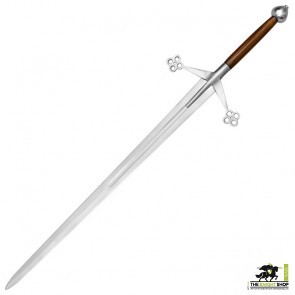
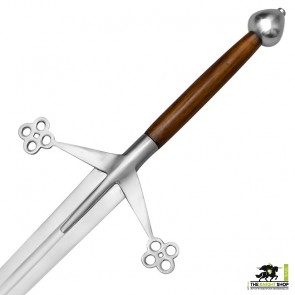
Two Handed Scottish Claymore
The Claymore (from the Scottish Gaelic claidheamh-mòr, meaning “great sword”) is a Scottish variant of the late medieval 2 handed sword. It differed from other longswords of the period in that it usually had forward sloping quillons terminating in quatrefoils. Claymores were in use during constant clan warfare and fights with the English from the 15th to 17th century. Claymores did exist as early as the Wars of Scottish Independence although they were smaller and few had the characteristic quatrefoil design. The last time that claymores were seen on the battlefield in any significant number was the Battle of Killiecrankie in 1689.
Our Two Handed Scottish Claymore has a hand-forged high carbon steel blade topped with solid steel hilt fittings and a stained real wood grip. This sword has a blunt blade and is designed for display only.
Overall Length: 123cm
Blade Length: 92cm
Blade Width: 5.8cm
Blade Thickness: 0.5cm
Guard Width: 29cm
Guard Depth: 2.9cm
Grip Length: 19cm
Blade: High Carbon Steel
Edge: Blunt
Pommel: Peened
Scabbard: None
All dimensions are approximate and may vary from piece to piece.Buy the Two Handed Scottish Claymore with confidence from the UK’s leading Medieval Sword retailer.
Learn More -


Nickel Claymore
The claymore (from Gaelic claideamh-mor, great sword) was a Celtic two-handed sword that was usually 150cm or longer. This length made it very difficult for opponents to approach. The claymore often had a long, leather-covered ricasso, so that the warrior could place both hands on the blade when his enemy came close. The earliest claymores were used in the 16th century, the latest in the 18th century.
Learn More
Total Length: 132cm
Blade Length: 102cm
Blade Width: 4.5cm
Blade Thickness: 0.5cm
Guard Width: 26.5cm
Grip Length: 18.5cm
Material: Steel Blade, Wooden Grip, Nickel Guard & Pommel
Edge: Blunt
Pommel: Nut
Scabbard: None
All dimensions are approximate and may vary from piece to piece. -


Brass Claymore
The claymore (from Gaelic claideamh-mor, great sword) was a Celtic two-handed sword that was usually 150cm or longer. This length made it very difficult for opponents to approach. The claymore often had a long, leather-covered ricasso, so that the warrior could place both hands on the blade when his enemy came close. The earliest claymores were used in the 16th century, the latest in the 18th century.
Learn More
Total Length: 133.5cm
Blade Length: 104cm
Blade Width: 5cm
Blade Thickness: 0.5cm
Guard Width: 26.5cm
Weight: 2396g
Material: Steel Blade, Wooden Grip, Brass Guard & Pommel
Edge: Blunt
Pommel: Nut
Scabbard: None
All dimensions are approximate and may vary from piece to piece. -
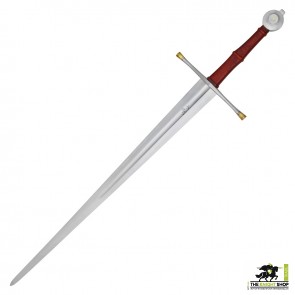

14th C. Passau Wolf Long Sword
This beautiful reproduction of a 14th-century sword bears the mark of the wolf of Passau, as it was drawn at that time. Its straight double-edged blade with a central groove offers a very slender and elegant profile, typical of two-handed swords from the 14th and 15th centuries. Its quillons are straight and decorated with brass tips.
Learn More
The round and wide pommel features a damascened cross decoration. This magnificent sword is offered with a very beautiful embossed leather scabbard, lined with a pattern of fleur-de-lis. The chape, bouterole, and brass fittings are finely pierced, as are the belt attachment elements that allow this weapon to be worn at the waist. It is a choice piece for your collection or reenactments.
Total Length: 115cm
Blade Length: 90cm
Blade Width: 6cm
Guard Width: 24.5cm
Grip Length: 18.5cm
P.O.B (from guard): 9cm
Edge: Blunt
Scabbard: Leather, Brass
All dimensions are approximate and may vary from piece to piece. -
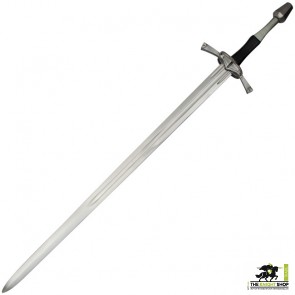
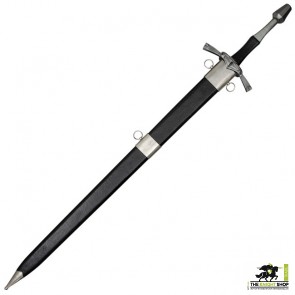
15th Century Ring Hilt Longsword
The 15th Century Ring Hilt Longsword differs from other longswords of the period in that it features “side rings” on either side of the guard. These rings provided greater protection to the hands without adding much weight to the sword. Over time, the addition of greater hand protection led more complex hit designs such as those seen on swept and basket hilt swords.
This longsword has a hand forged high carbon fullered steel blade (not tempered) with a triple fullered ricasso. The bottom half of the grip is wrapped in black leather. The top half is wire-bound for a more decorative finish and greater purchase. This sword comes complete with a well-made wooden scabbard wrapped in black leather with steel fittings and belt rings. This item has a blunt blade and is manufactured for display only.
Overall Length: 118.5cm
Blade Length: 92cm
Grip Length: 18.5cm
Guard Width: 20cm
Blade Width: 4.5cm
Weight: 1694g
Blade: High Carbon Steel
Edge: Blunt
Pommel: Peened
Scabbard: Wood, Leather, Steel
All dimensions are approximate and may vary from piece to piece.Buy the 15th Century Ring Hilt Longsword with confidence from the UK’s leading Medieval Sword retailer.
Learn More