





Roman Swords
-


Roman Mainz Gladius
The Roman Gladius was the primary weapon of the Roman Legionary and was used in conjunction with the 'Scutum' (shield) and 'Pilum' (spear). Its design was strongly influenced by the swords used by the Iberian (Spanish) Celts. It was predominantly designed as a thrusting weapon and was in use in one form or another from the 4th Century BC to the 3rd Century AD.
This sword ("gladius" in Latin) found in Mainz, Germany has a leaf-shaped, double-edged blade. It was as effective for cuts as it was for thrusts, which means it was the perfect sword for close combat. The bone grip is characteristic of this type of gladius and the guard prevents your hand from slipping onto the blade after a strong thrust. The ample pommel keeps your hand on the grip after strong cuts. A scabbard with ornamental brass applications comes with this Mainz type gladius.Our Roman Mainz Gladius features a turned wood pommel and bone grip. The straight blade is hand forged from steel and is housed in a wooden scabbard with red leather covering and decorated brass fittings.
This sword is not designed or recommended for contact reenactment (fighting) but is favoured by living history enthusiasts.
Overall Length: 72cm
Blade Length: 54cm
Blade Width: 6.5cm
Blade Thickness: 0.5cm
Weight: 818g
Material: EN45 High Carbon Steel
Edge: Blunt
Pommel: Nut
Scabbard: Wood, Leather, Brass
All dimensions are approximate and may vary from piece to piece.Buy the Roman Mainz Gladius with confidence from the UK’s leading Roman sword retailer.
Learn More -

Roman Pompeii Gladius - Decorated
The Roman Gladius was the primary weapon of the Roman Legionary and was used in conjunction with the 'Scutum' (shield) and 'Pilum' (spear). Its design was strongly influenced by the swords used by the Iberian (Spanish) Celts. It was predominantly designed as a thrusting weapon and was in use in one form or another from the 4th Century BC to the 3rd Century AD.
The Pompeii Gladius takes its name from the archaeological site in Italy where, during excavations, 4 such swords were found. The swords are dated to before 79AD - the year that Pompeii was buried in volcanic ash. The Pompeii Gladius, along with the earlier Mainz Pattern Gladius, would have been issued to the garrison at Hadrian’s Wall. Examples can be seen in H. Russell Robinson’s book "What The Soldiers Wore On Hadrians Wall'".
Our Pompeii Gladius features a turned wood pommel and bone grip. The straight blade is hand forged from steel and in housed in a wooden scabbard with red leather covering and decorated brass fittings. This sword is not designed or recommended for contact reenactment (fighting) but is favoured by living history enthusiasts.
Overall Length: 70cm
Blade Length: 48cm
Width: 4.9cm
Grip Length: 10.8cm
Weight: 1135g
Thickness: 5mm
P.O.B: 11cm
Edge: Blunt
Pommel: Threaded
Scabbard: Wood, Leather, Brass
All dimensions are approximate and may vary from piece to piece.Buy the Roman Pompeii Gladius – Decorated with confidence from the UK’s leading Roman sword retailer.
Learn More -


Roman Legionary Pompeii Gladius
The Roman Gladius was the primary weapon of the Roman Legionary and was used in conjunction with the 'Scutum' (shield) and 'Pilum' (spear). Its design was strongly influenced by the swords used by the Iberian (Spanish) Celts. It was predominantly designed as a thrusting weapon and was in use in one form or another from the 4th Century BC to the 3rd Century AD.
The Pompeii Gladius takes its name from the archaeological site in Italy where, during excavations, 4 such swords were found. The swords are dated to before 79AD - the year that Pompeii was buried in volcanic ash. The Pompeii Gladius, along with the earlier Mainz Pattern Gladius, would have been issued to the garrison at Hadrian’s Wall. Examples can be seen in H. Russell Robinson’s book "What The Soldiers Wore On Hadrians Wall'".
Our Pompeii Gladius features a turned wood pommel and bone grip. The straight blade is hand forged from steel and housed in a wooden scabbard with red leather covering and brass fittings.
This sword is not designed or recommended for contact reenactment (fighting) but is favoured by living history enthusiasts.
Total Length: 76cm
Blade Length: 49cm
Scabbard: Wood and Leather
All dimensions are approximate and may vary from piece to piece.Buy the Roman Legionary Pompeii Gladius with confidence from the UK’s leading Roman sword retailer.
Learn More -
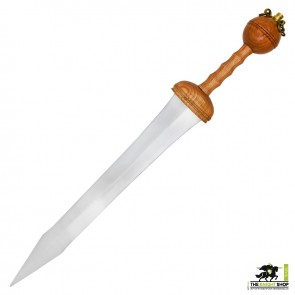
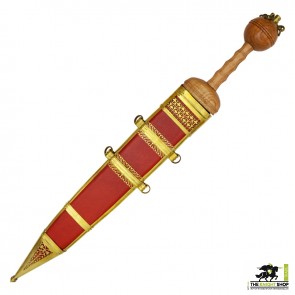
Dubrabica Roman Gladius
Step into the ranks of Roman military elite with the Dubravica Roman Gladius, a meticulously crafted reproduction based on a rare archaeological find near Dubravica in Eastern Europe. Unlike the standard legionary gladius, this extraordinary piece features a wooden pommel crowned with four brass rings, believed to denote rank or ceremonial significance.
Learn More
Crafted by Deepeeka, a global leader in historical replicas, this gladius brings together archaeological accuracy, craftsmanship, and heritage—ideal for discerning collectors, museums, and Roman reenactment specialists.
Blade Material: High Carbon Steel
Pommel Material: Hardwood with four bronze rings
Grip: Ribbed wooden handle
Scabbard: Ornate leather with brass detailing
Total Length: 76cm
Blade Length: 54.5cm
Blade Width: 6.5cm
Guard Width: 9cm
Grip Length: 10.5cm
P.O.B (from guard): 11cm
Edge: Blunt
All dimensions are approximate and may vary from piece to piece.